AQA GCSE Magnification and lenses (Physics)
This video is hosted by YouTube (Google). Allow Optional functionality in Cookie settings to load it. YouTube may then store or access information on your device and receive information about your visit.
Magnification
Magnification is the number of times larger or smaller an image appears, compared to the original object size.

Key points
1.Make sure that the image height and the object height are both in the same units.
2. If the magnification is:
| Magnification | Image to object size | Result |
|---|---|---|
| Greater than 1 | Image larger than object | Object magnified to form a larger image |
| Equal to 1 | Image same size as object | Same size |
| Less than 1 | Image smaller than object | Object is diminished in size to form a smaller image |
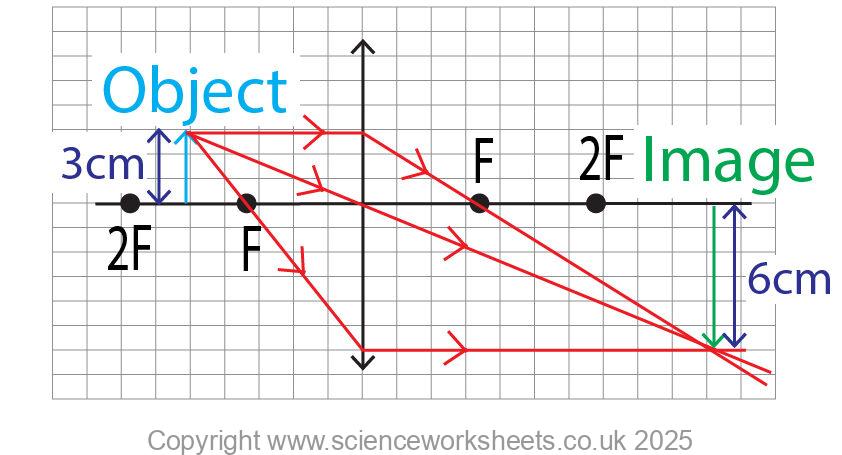
In the image below, the convex lens is forming a real image of an object that is larger than the object and inverted.
Each square is 1cm x 1cm.
The object height is 3 squares, 3cm.(horizontal line to top of blue arrow)
The image height is 6 squares, 6cm(horizontal line to bottom of green arrow).

Practice Question
1.State the formula to calculate magnification
2. Describe what is meant by the term magnification
3. If a magnification of 0.8 is calculated, would the image be smaller or larger than the original object?
4. Sarah measured her image height as 0.15m and her object height as 7.5cm. Calculate her magnification
5. On the grid below each box is 1cm x 1cm.
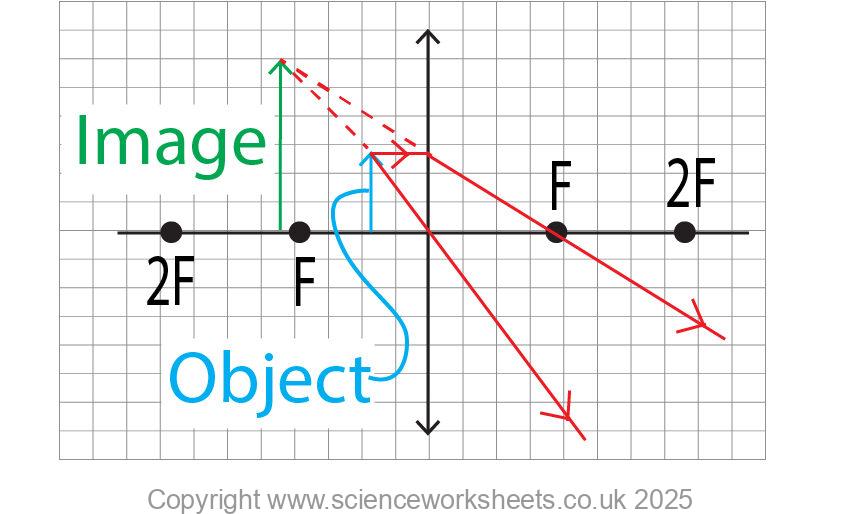
5a. In the image above, each box is 1cm x 1cm. Calculate the magnification.
Absorption and Emission of EM Radiation
JJ Thomson and Plum pudding model
Ernest Rutherford and the Nuclear Model
Niels Bohr changing the Nuclear Model
Discovering the Proton and Neutron
Measuring radiation from radioactivity
Radiation types and properties
Random nature of radioactive decay
Radioactive contamination or irradiation
Hazards of contamination and irradiation
Studies on the effects of radiation on humans
Different half lives of radioactive isotopes
Nuclear Fission Chain Reaction
Writing nuclear fission equations
Drawing ray diagrams for a concave lens
Drawing Ray Diagram to produce a virtual image for a convex lens
Drawing ray diagram to produce a real image for a convex lens.
Specular and Diffuse Reflection
Seeing Coloured Objects Part 2
Viewing objects through coloured filters
Transparent, Translucent and Opaque