AQA GCSE Colours of white light(Physics)
This video is hosted by YouTube (Google). Allow Optional functionality in Cookie settings to load it. YouTube may then store or access information on your device and receive information about your visit.
Colours of White Light
White light is made up of 7 different colours of light. White light can be split up into these 7 colours using a glass prism. This process is called dispersion.
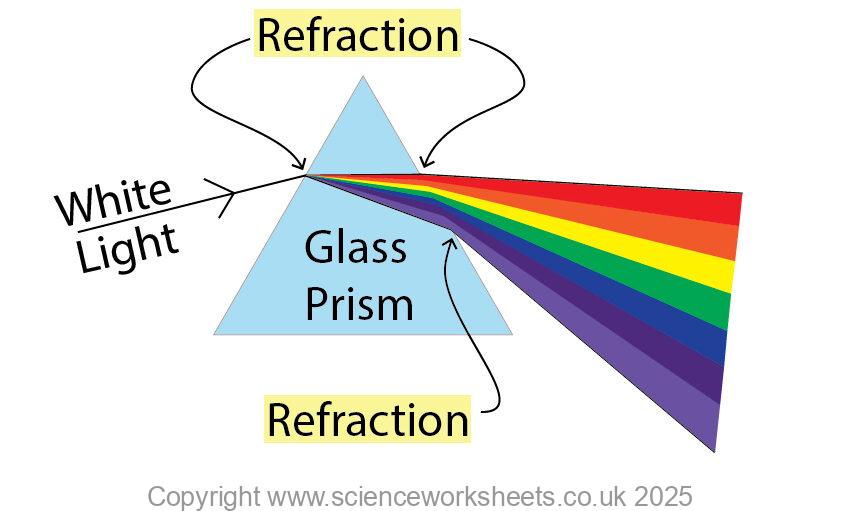
As the white light enters the prism it is refracted. The violet light component is refracted more than the red light. This is why the white light splits up into different colours.
Also, note that the light is refracted twice, once on entering the prism and once on leaving the prism.
Primary and Secondary colours of light
There are primary colours of light and secondary colours of light as shown below.
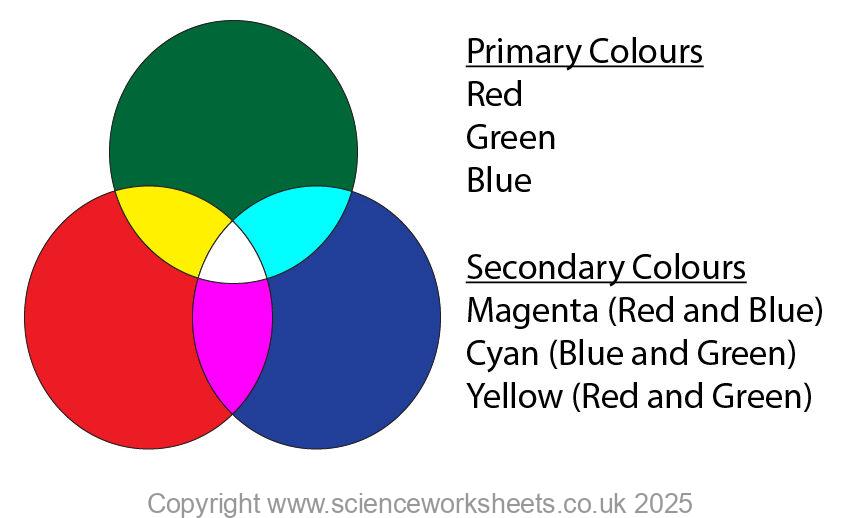
When two primary colours are mixed together, they form a secondary colour.
E.g. Red and Green light will make yellow light. This is shown in the diagram above.
If all 3 primary colours are mixed together then white light is made.
Summary table for Secondary colours of light
| Secondary colour of light | Contains these primary colours |
|---|---|
| Magenta | Red and Blue |
| Cyan | Blue and Green |
| Yellow | Red and Green |
Practice Question
1.Write down the names of primary light colours which make up white light
2. Write down the names of the secondary light colours which make up white light
3. A red beam of light is mixed with a Cyan beam of light. What colour light is produced?
Absorption and Emission of EM Radiation
JJ Thomson and Plum pudding model
Ernest Rutherford and the Nuclear Model
Niels Bohr changing the Nuclear Model
Discovering the Proton and Neutron
Measuring radiation from radioactivity
Radiation types and properties
Random nature of radioactive decay
Radioactive contamination or irradiation
Hazards of contamination and irradiation
Studies on the effects of radiation on humans
Different half lives of radioactive isotopes
Nuclear Fission Chain Reaction
Writing nuclear fission equations
Drawing ray diagrams for a concave lens
Drawing Ray Diagram to produce a virtual image for a convex lens
Drawing ray diagram to produce a real image for a convex lens.
Specular and Diffuse Reflection
Seeing Coloured Objects Part 2
Viewing objects through coloured filters
Transparent, Translucent and Opaque