Drawing and interpreting nuclear fission diagrams
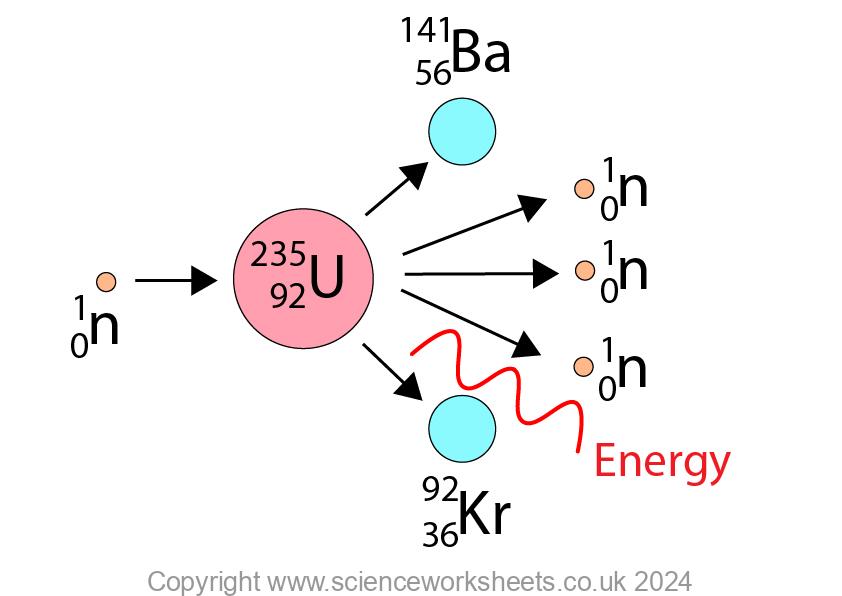
You are expected to be able to draw and interpret diagrams like the one below
Lets try drawing a diagram for the following equation
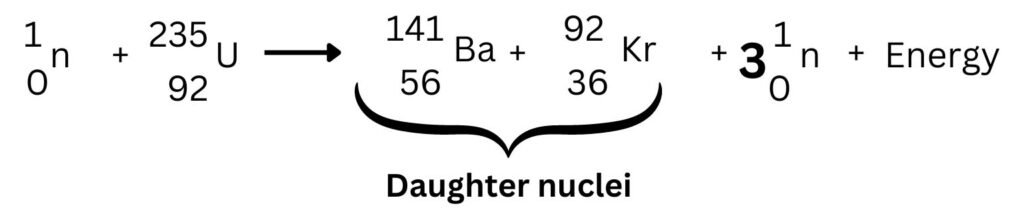
First we will draw a slow moving neutron being absorbed by the U-235 nucleus, then draw the two daughter nuclei Ba-141 and Kr-92, finally draw 3 neutrons leaving.

You should be able to draw simplified block diagrams like this, provided it is clearly labelled such as the one above. If you want to you can draw the tiny circles to represent the protons and neutrons, but this is probably not needed.
Draw a diagram for a chain reaction.
In each nuclear fission reaction, 1 neutron is used and 3 are produced. These 3 neutrons will go on and cause further fission reactions.
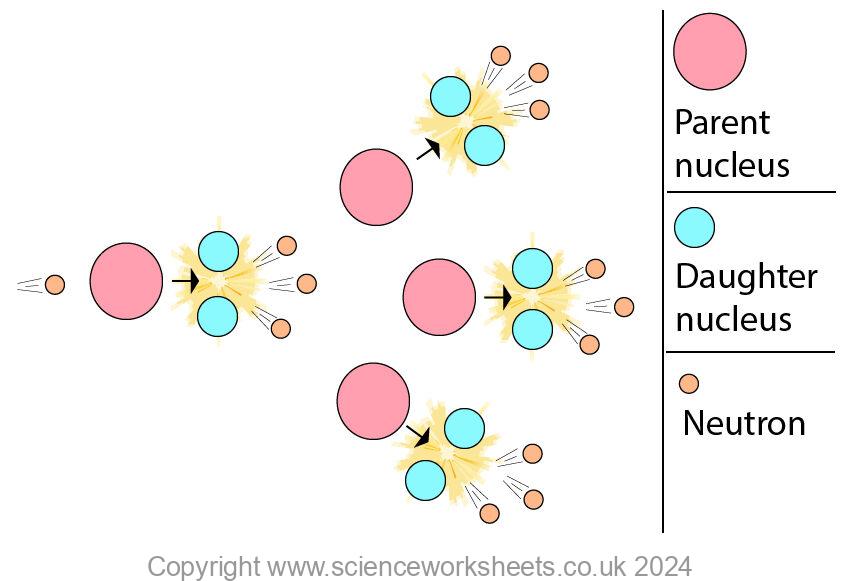
We can simplify this diagram to leave out the daughter nuclei.

In the first fission reaction, 3 neutrons are produced. These 3 neutrons will then go on and cause further fission reactions as shown
Practice Questions
1. Draw a diagram to represent the following equation

2. Draw a diagram to represent the following equation
