AQA GCSE History of genetics (Biology)
History of genetics
Genetics explains how characteristics are inherited.
Our understanding has developed over time through scientific discoveries. Different scientists contributed evidence that built the modern gene theory.
Mendel’s Work (mid-19th century)
Gregor Mendel carried out breeding experiments on pea plants. He studied characteristics like flower colour in the pea plants.
He discovered that inheritance is controlled by ‘units’ (now called genes). These units are passed on unchanged from parents to offspring.

Why Mendel’s work was not recognised.
His work was not accepted at the time because:
1.Scientists didn’t understand chromosomes or genes
2.His idea that inheritance is controlled by separate units conflicted with the popular theory of blending inheritance.
3.His work was not widely shared or understood
Only later was his work appreciated
Discovery of Chromosomes (late 19th century)
Scientists observed chromosomes during cell division (mitosis and meiosis)
Chromosomes were seen to:
1.Chromosomes come in homologous pairs, with one chromosome in each pair inherited from the mother and the other from the father.
2.During gamete formation, chromosome pairs separate so that each gamete receives only one chromosome from each pair, resulting in half the normal number of chromosomes.
This suggested that chromosomes play a role in passing on characteristics from parents to offspring.

Linking Mendel’s Ideas to Chromosomes (early 20th century)
Scientists observed that chromosomes behave in the same way as Mendel’s ‘units’, as they occur in pairs and separate during gamete formation. This led to the conclusion that genes are located on chromosomes.

Discovery of DNA Structure (mid-20th century)
Scientists discovered that DNA is the genetic material. James Watson and Francis Crick determined its double helix structure. This structure allows DNA to store and transmit genetic information. Genes are sections of DNA that code for specific proteins, which determine characteristics.

Modern Gene Theory
Genes are made of DNA. Genes are located on chromosomes. Genes control characteristics by coding for proteins.
This understanding developed from the work of many scientists over time.
Conclusion
Our understanding of genetics developed gradually. Mendel’s work was crucial but only recognised later. Advances in technology helped scientists build modern gene theory.
Timeline
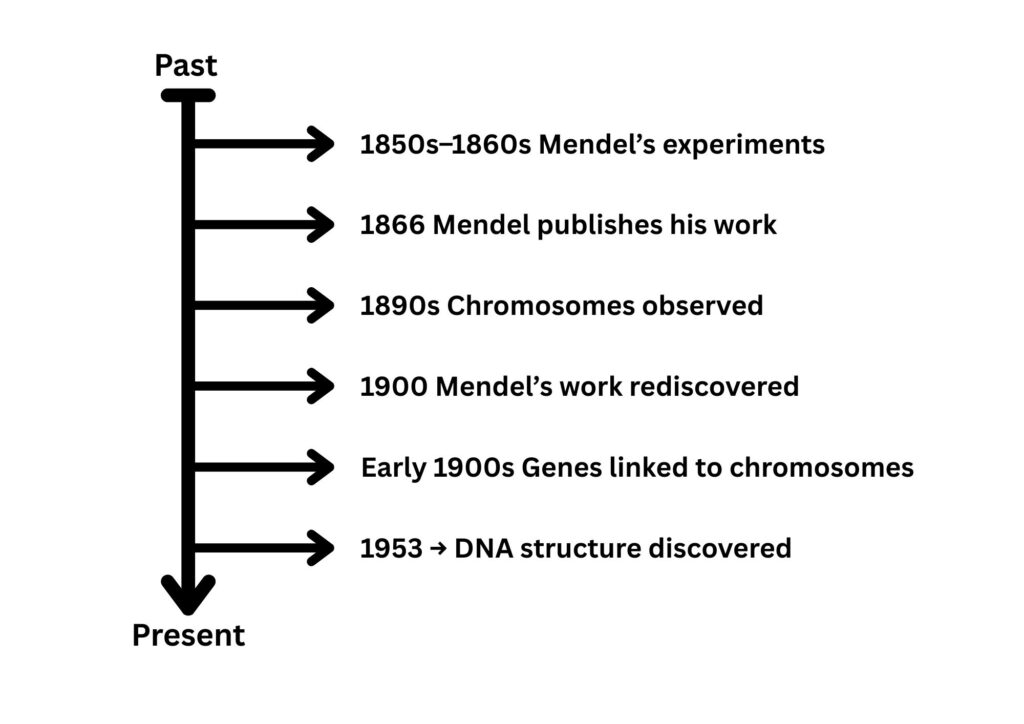
Practice Questions
1.Who carried out breeding experiments on pea plants in the 19th century?
2.Give two reasons why Mendel’s work was not recognised at the time.
3.Scientists observed that chromosomes separate during gamete formation.
Explain how this supports Mendel’s ideas about inheritance.
Factors affecting the rate of photosynthesis
Measuring & calculating rates of photosynthesis
Inverse square law and photosynthesis
Economics of enhancing the conditions in greenhouses
Investigating the effect of light intensity on the rate of photosynthesis
Data analysis and nervous system
The effect of a factor on human reaction time
Controlling blood glucose concentration
Regulating water and nitrogen levels in the body.
Hormones and human reproduction
Using hormones to treat infertility
Control and coordination in plants using hormones
Investigating the effect of light or gravity on the growth of newly germinated seedlings