AQA GCSE Pedigree diagrams(Biology)
Pedigree diagrams
A pedigree diagram is a chart showing how a trait is inherited through generations of a family.
Pedigree diagrams are normally based on either a dominant or recessive trait.
Pedigree diagram (Dominant trait)
If characteristic or trait is caused by a dominant allele, then the individual will only need to inherit one copy of the dominant allele to express the characteristic.
Polydactyly is a disorder caused by dominant allele.
D = polydactyly, d = normal

Inidividual 2 is dd because they do not suffer from the condition. However, we can see that individual 1 could be DD or Dd.
Below are examples of a punnett square that will allow us to identify the genotype of individual 1.
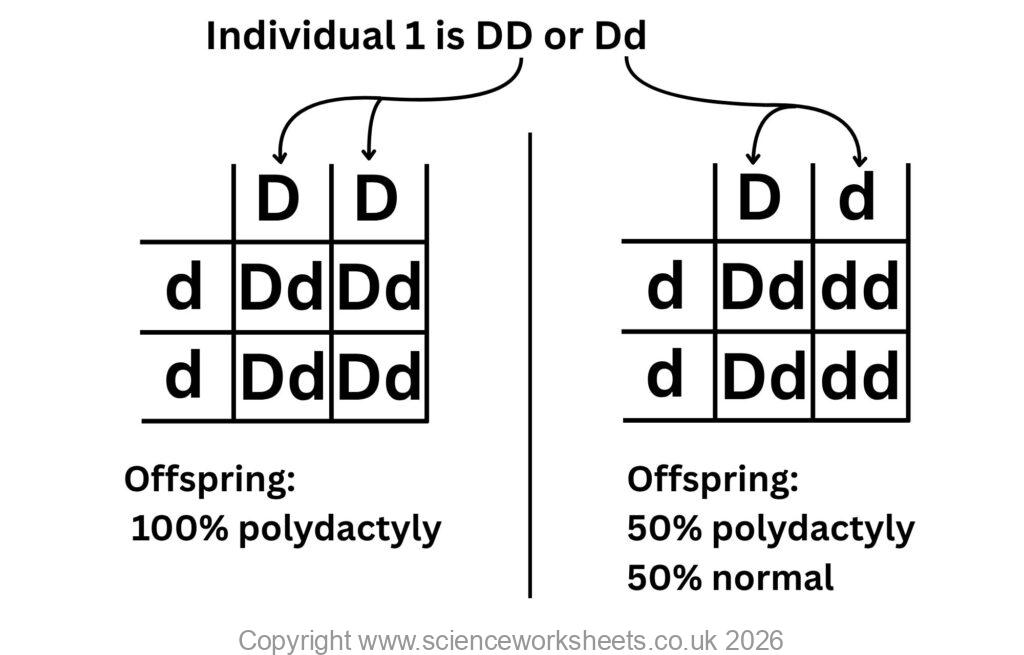
As the offspring of 1 and 2 are a mixture of some having polydactyly and some not, it means that individual 1 is Dd and not DD.
Pedigree diagram (Recessive trait)
If characteristic or trait is caused by a recessive allele, then the individual will need to inherit two copies of the recessive allele to express the characteristic.
Cystic fibrosis is a disorder caused by a recessive allele.
F= normal, f = cystic fibrosis

The individuals that do not have cystic fibrosis (1,2,4,5,6) could be FF or Ff.
However, individual 3 with cystic fibrosis can only be ff.

This means that individual 3 would had received one recessive allele from each of its parents (individuals 1 and 2).

However, as neither 1 or 2 suffer from the disease, it means that both of them must also carry a dominant allele in addition to their recessive allele

Practice Questions
1.Describe what a pedigree diagram shows us.
2.Huntingdon’s disorder is caused by a dominant allele H. People with two copies of the recessive alleles (hh) are unaffected. Below is a pedigree diagram for huntingdon’s disease.

Both individuals 1 and 2 have Huntingdon’s disease. Explain how it is possible for them to have children that will not suffer from the disorder.
3. Tay Sachs disease is caused by a recessive allele t. People with T are unaffected by the disease. Below is a pedigree diagram for Tay Sachs disease.

Parents 6 and 7 have two children. Child 9 has Tay sachs. Explain how this is possible.
Factors affecting the rate of photosynthesis
Measuring & calculating rates of photosynthesis
Inverse square law and photosynthesis
Economics of enhancing the conditions in greenhouses
Investigating the effect of light intensity on the rate of photosynthesis
Data analysis and nervous system
The effect of a factor on human reaction time
Controlling blood glucose concentration
Regulating water and nitrogen levels in the body.
Hormones and human reproduction
Using hormones to treat infertility
Control and coordination in plants using hormones
Investigating the effect of light or gravity on the growth of newly germinated seedlings