AQA GCSE Selective Breeding (Artificial Selection)(Biology)
Selective Breeding (Artificial Selection)
Selective breeding is when humans choose which plants or animals reproduce to get desirable characteristics.
Humans have been doing this for thousands of years since they first bred food crops from wild plants and domesticated animals.
What is Selective Breeding?
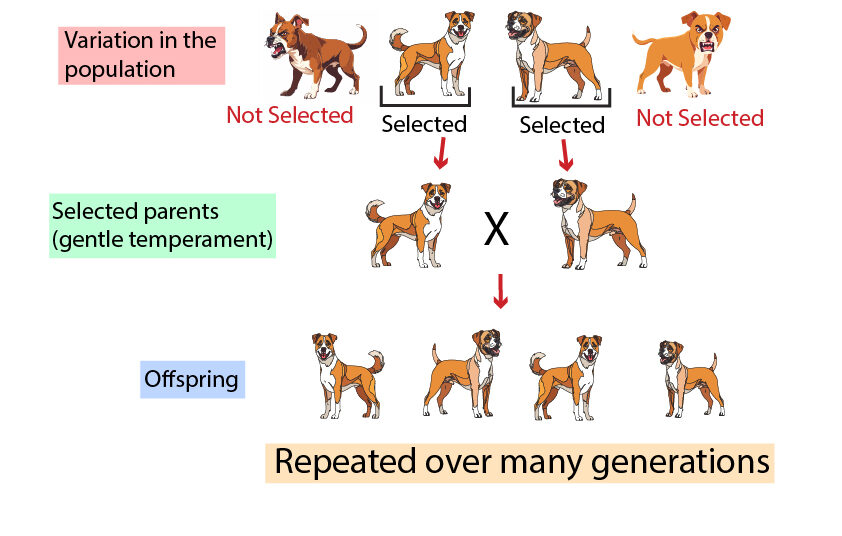
1.Humans choose parents with desired characteristics. In the example below dogs with a gentle temperament (good nature) are chosen over those with an agressive temperament (aggressive ones)
2.They are bred together (dogs with gentle temperament)
3.Offspring with the best traits are selected. In this case the offspring which show a good temperament are bred together.
4.Process is repeated over many generations
Over time, this increases the frequency of desirable alleles in the population.
Examples
Selective breeding is used to produce:
Disease-resistant crops
Cows producing more milk
Chickens producing more eggs
Dogs with a gentle temperament
Plants with larger flowers
Benefits of Selective Breeding
Increased crop and meat yield, which increases food production
Improved quality (taste, size, appearance)
Disease-resistant crops
Animals with useful traits
Risks / Disadvantages
Due to Inbreeding (breeding together closely related organisms) which reduces genetic variation.
Inbreeding and reduced variation gives a higher chance of genetic disorders as harmful recessive alleles are more likely to be expressed
Population more vulnerable to disease which can raise ethical concerns (animal welfare)
Practice Questions
1.What is meant by selective breeding?
2.Describe the process of selective breeding.
3.The diagram above shows selective breeding in dogs. Explain how the dogs with a gentle temperament become more common over time.
Factors affecting the rate of photosynthesis
Measuring & calculating rates of photosynthesis
Inverse square law and photosynthesis
Economics of enhancing the conditions in greenhouses
Investigating the effect of light intensity on the rate of photosynthesis
Data analysis and nervous system
The effect of a factor on human reaction time
Controlling blood glucose concentration
Regulating water and nitrogen levels in the body.
Hormones and human reproduction
Using hormones to treat infertility
Control and coordination in plants using hormones
Investigating the effect of light or gravity on the growth of newly germinated seedlings