AQA GCSE Mutations(Biology)
Mutations
A mutation is a random change in the DNA base sequence.
Mutations occur continuously and provide a source of variation.
As a result of the DNA base sequence changing, most mutations do not alter the protein, or only alter it slightly so that its appearance or function is not changed. A few mutations code for an altered protein with a different shape, so the protein is no longer functional.
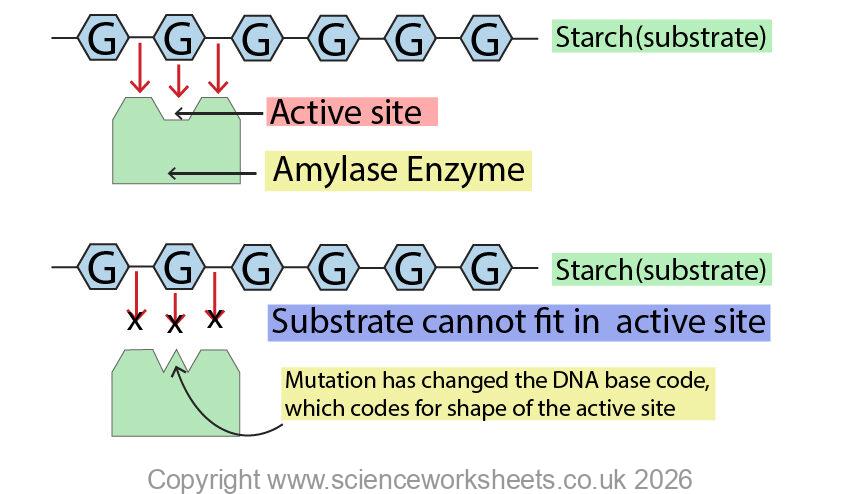
An example below shows how a mutation has changed the DNA base code, which results in the shape of the active site for an enzyme to change. As a result the substrate can no longer bind to the active site.
If a mutation changes the DNA base sequence for a gene that codes for a structural protein, it can significiantly weaken the structural protein.
An example is a mutation that causes Ehlers-Danlos Syndrome. The gene that codes for collagen molecule undergoes a mutation and collagen is not synthesised correctly, or becomes broken down. See below

How the mution affects a protein
When a mutation occurs it can change the DNA base sequence by either inserting or deleting a base.
Insertion of a base
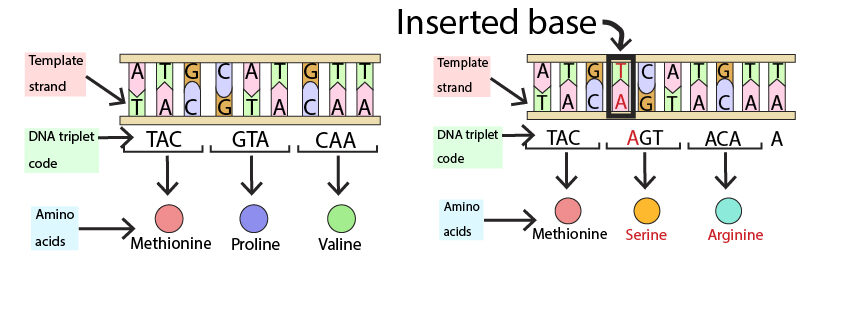
In an insertion mutation an extra base is added into the DNA.
In the diagram below compare the DNA on the left (normal DNA) to the right (mutated DNA).
The extra base has changed the triplet code from GTA to AGT, which has changed the amino acid from proline to serine.
However, because the DNA is read in groups of 3, it will also affect other amino acids after this point.
Deletion of a base
In a deletion mutation a base is removed the DNA.
In the diagram below compare the DNA on the left (normal DNA) to the right (mutated DNA).
The base C-G has beeen removed to change the DNA from the normal to the mutated version.
This has the result of changing the 2nd triplet code from GTA to TAC as the bases are read in groups of 3.
This will change the 2nd amino acid from proline to methionine

Mutation on a non coding section of DNA
Non-coding parts of DNA have regulatory functions. They can switch genes off or on.
If a mutation occurs on a non coding section of DNA, it can result in switching off a gene, or switching it on. As a result, it can have a large effect on the organism.
Practice Questions
1.What is meant by a mutation?
2.Explain why many mutations have no effect on an organism.
3. Explain why mutations in non-coding regions can be important even though they do not code for proteins.
Factors affecting the rate of photosynthesis
Measuring & calculating rates of photosynthesis
Inverse square law and photosynthesis
Economics of enhancing the conditions in greenhouses
Investigating the effect of light intensity on the rate of photosynthesis
Data analysis and nervous system
The effect of a factor on human reaction time
Controlling blood glucose concentration
Regulating water and nitrogen levels in the body.
Hormones and human reproduction
Using hormones to treat infertility
Control and coordination in plants using hormones
Investigating the effect of light or gravity on the growth of newly germinated seedlings