AQA GCSE Blood (Biology)
Blood
Typical human body contains about 4.7 to 5 litres of blood.
Blood is a tissue because it contains cells with a similar structure and function.
Blood contains:
1.Plasma
2.Red blood cells
3.White blood cells
4.Platelets
Blood can be separated out using a centrifuge. These are the layers that form:
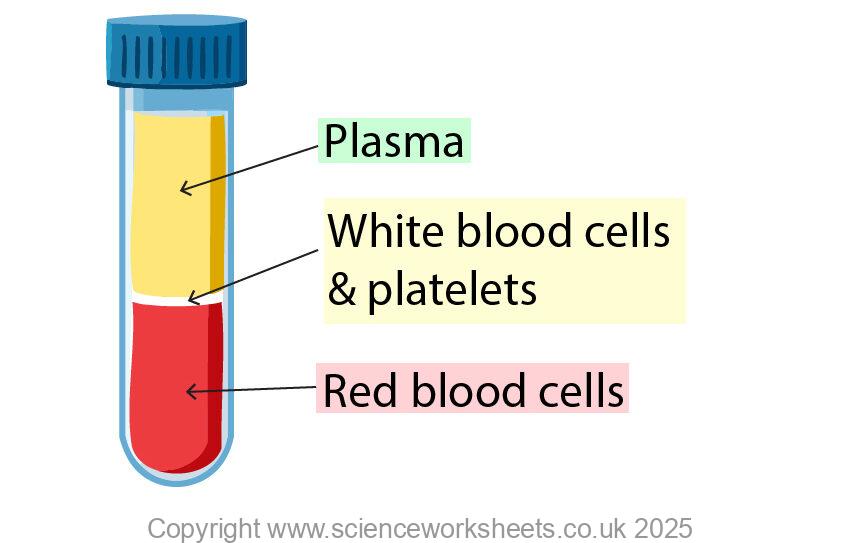
Plasma
This makes up approx 55% of all blood and it is a straw yellow colour.
The blood cells, such as red and white cells, along with the platelets are suspended in the plasma.
Many other substances are dissolved in the blood plasma.
Plasma’s main role is to transport substances around the body.
| Name of Substance in plasma | Transported from | Transported to |
|---|---|---|
| Carbon dioxide | Body cells | Lungs |
| Urea | Liver cells | Kidneys |
| Glucose | Small intestine | Body cells |
Red blood cells
Red blood cells transport oxygen around the body.
Red blood cell has a biconcave disc shape. This means that it is indented on both sides as shown below. This will increase its surface area to volume ratio for diffusion of oxygen

Red blood cells do not have a nucleus, this gives them more space to carry haemoglobin.
Oxygen binds to haemoglobin to form oxyhaemoglobin when the red blood cell is near the lungs. When the red blood cells is near the tissues, the oxyhaemoglobin breaks down to release the oxygen for body tissues.

White blood cells
White blood cells form part of our bodies immune system against pathogens.
There are three main types
1.Phagocytes
Phagocytes engulf the pathogen (bacterium), then use digestive enzymes to break down the pathogen (bacterium).

Lymphocytes
There are two types of lymphocytes:
The first type will produce antibodies which bind to antigens on pathogens. Once the antibody has bound to the antigen on the pathogen, the pathogen will be killed.

The second type of lymphocyte will produce antitoxins to neutralise toxins produced by bacterial pathogens.

Platelets
Platelets are fragments of blood cells, they are involved in the clotting of blood to seal wounds. This prevents blood loss and prevents pathogens from entering the body.
When an area of skin is damaged a soluble protein in the blood, fibrinogen is converted into insoluble fibrin.
The fibrin forms a mesh, which traps platelets, blood cells forming a clot, this will dry to form a scab, sealing the wound.
Viewing Blood under the microscope.
You will need to be able to recognise different blood cells.

Practice Questions
1.How much blood is in the human body?
2. Fill in the table below to summarise function of each component of blood.
| Component of blood | Function |
|---|---|
| Plasma | |
| Red blood cells | |
| White blood cells | |
| Platelets |
3. Explain how white blood cells form part of our immune system.
Factors affecting the rate of photosynthesis
Measuring & calculating rates of photosynthesis
Inverse square law and photosynthesis
Economics of enhancing the conditions in greenhouses
Investigating the effect of light intensity on the rate of photosynthesis
Data analysis and nervous system
The effect of a factor on human reaction time
Controlling blood glucose concentration
Regulating water and nitrogen levels in the body.
Hormones and human reproduction
Using hormones to treat infertility
Control and coordination in plants using hormones
Investigating the effect of light or gravity on the growth of newly germinated seedlings