AQA GCSE Active Transport(Biology)
Active Transport.
Active transport moves substances from a more dilute solution to a more concentrated solution (against a concentration gradient), using energy from respiration.
On the left is a dilute solution which contains a high concentration of water molecules and a low concentration of solute.
On the right is a concentrated solution which contains a low concentration of water and a high concentration of solute.
The solute molecules are moved from the dilute solution to the concentrated solution by active transport. To do this energy is needed along with carrier molecules.
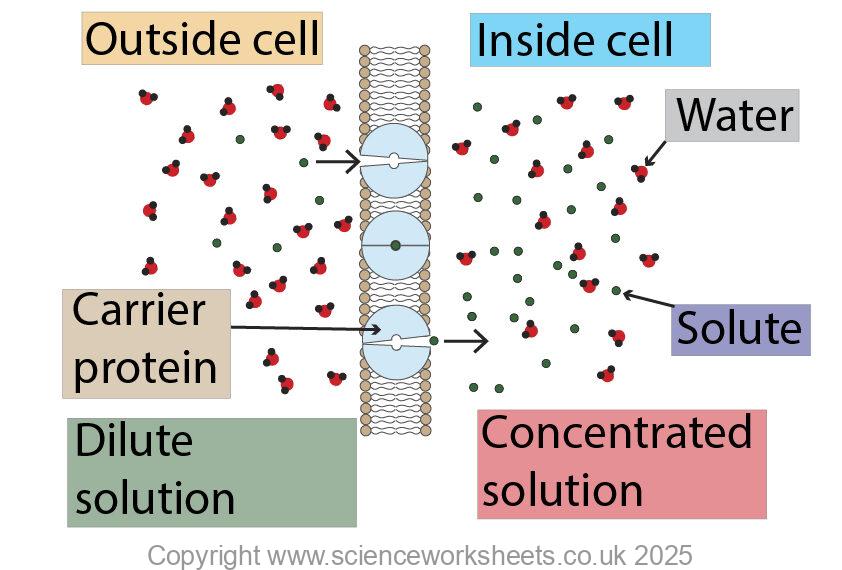
How active transport works
When the solute molecule enters the carrier protein, energy is used to change the shape of the carrier molecule, allowing the solute molecule to leave on the other side of the membrane.
The energy is released by the process of respiration of glucose.
If respiration stops for any reason, then active transport stops.
Active transport in plants
Root hair cells of plants absorb mineral ions such as nitrate ions from very dilute soil solutions by active transport.
The soil contains a dilute solution of mineral ions, whilst the root hair cell represents a concentrated solution of mineral ions.
The mineral ions are moved against a concentration gradient, using energy from respiration.
Nitrate ions once absorbed by active transport are combined with glucose from photosynthesis to make amino acids. These amino acids are joined together to make proteins for growth.

Active transport in animals
Sugar molecules move from the small intestine (low sugar concentration) into the blood (high sugar concentration) by active transport. This needs energy, which is provided by respiration.
The blood will then transport the sugar to other body cells for respiration.

Practice Question
1.Define the term active transport
2. Explain the difference between a dilute solution and a concentrated solution.
3. Explain how active transport allows substances to move against a concetration gradient.
Factors affecting the rate of photosynthesis
Measuring & calculating rates of photosynthesis
Inverse square law and photosynthesis
Economics of enhancing the conditions in greenhouses
Investigating the effect of light intensity on the rate of photosynthesis
Data analysis and nervous system
The effect of a factor on human reaction time
Controlling blood glucose concentration
Regulating water and nitrogen levels in the body.
Hormones and human reproduction
Using hormones to treat infertility
Control and coordination in plants using hormones
Investigating the effect of light or gravity on the growth of newly germinated seedlings