AQA GCSE Acceleration (Combined Science)
This video is hosted by YouTube (Google). Allow Optional functionality in Cookie settings to load it. YouTube may then store or access information on your device and receive information about your visit.
Acceleration
Acceleration is defined as the rate of change of velocity.
Acceleration is a vector quantity, so it has both a magnitude and direction.
Speeding up and Slowing down
Although the definition for acceleration is the rate of change of velocity, this can be hard to understand.
A more simple way to understand acceleration is that:
1. Object speeds up it is acceleration
2.Object slows down it is decelerating.
The above defintions are simplifications, so they do have some limitations, but they allow you to understand the topic more easily.
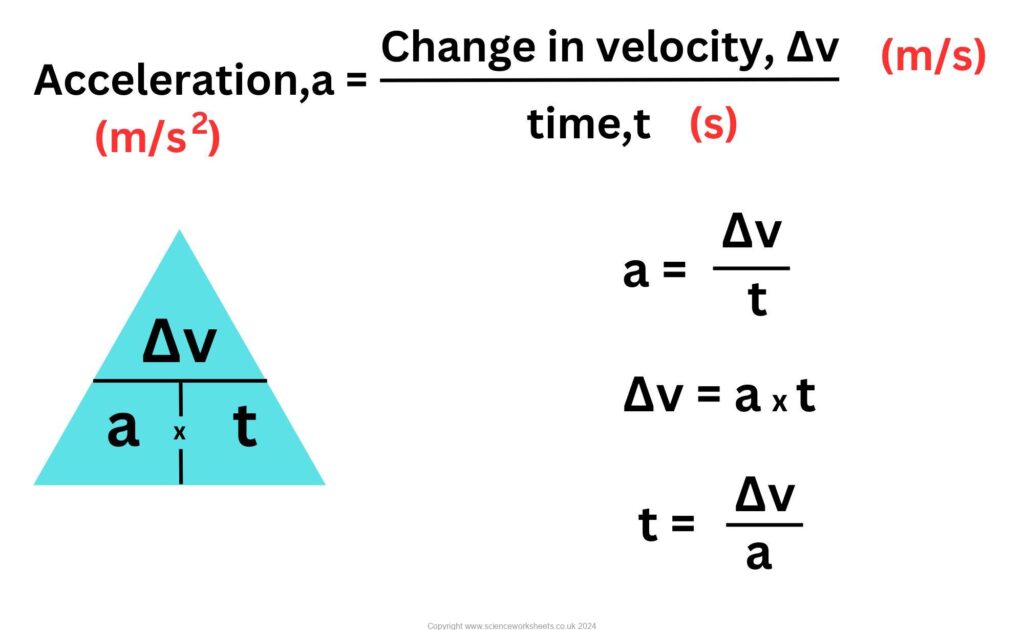
Example Calculation
1.A car is moving along a road in a forwards direction at 10m/s. The car then does an emergency brake and comes to rest 2.5 seconds later.
1a. Calculate the acceleration of the car
Acceleration = Change in velocity/time
Initial velocity =10m/s
Final velocity = 0m/s as the car comes to a rest
Change in velocity = Final velocity – Initial velocity
Change in velocity = 0m/s – 10m/s = -10m/s
Acceleration = -10/2.5 = -4m/s2
1b. Calculate the deceleration of the car
Deceleration does not need a negative sign, so the deceleration of the car would be 4m/s2
2.A person starts to run from rest, increasing their velocity over a period of 3 seconds to 5m/s. Calculate the person’s acceleration
Acceleration = change in velocity/time
Change in velocity = Final velocity – Initial velocity
Final velocity = 5m/s
Initial velocity 0m/s as runner starts from rest.
Change in velocity = 5m/s – 0m/s = 5m/s
Acceleration = 5/3 = 1.7m/s2
Typical acceleration values
| Activity | Acceleration (m/s2) |
|---|---|
| Baby crawling | 0.1 |
| Person walking | 0.5 |
| Person cycling | 1.0 |
| Aeroplane taking off | 3.0 |
Practice Questions
1.State the definition of acceleration.
2.If a car increases its velocity from 10 m/s to 30 m/s in 5 seconds, what is its acceleration?
3.What does a negative acceleration indicate?
4.If an object moves with constant velocity, what is its acceleration?
5.A car decelerates from 25 m/s to 5 m/s in 4 seconds. What is its acceleration?
6.A ball is dropped from a height on Earth. What is its initial acceleration?
7.If an object’s acceleration is zero, what can be said about its motion?
Absorption and Emission of EM Radiation
JJ Thomson and Plum pudding model
Ernest Rutherford and the Nuclear Model
Niels Bohr changing the Nuclear Model
Discovering the Proton and Neutron
Measuring radiation from radioactivity
Radiation types and properties
Random nature of radioactive decay
Radioactive contamination or irradiation
Hazards of contamination and irradiation
Studies on the effects of radiation on humans