Practice Questions
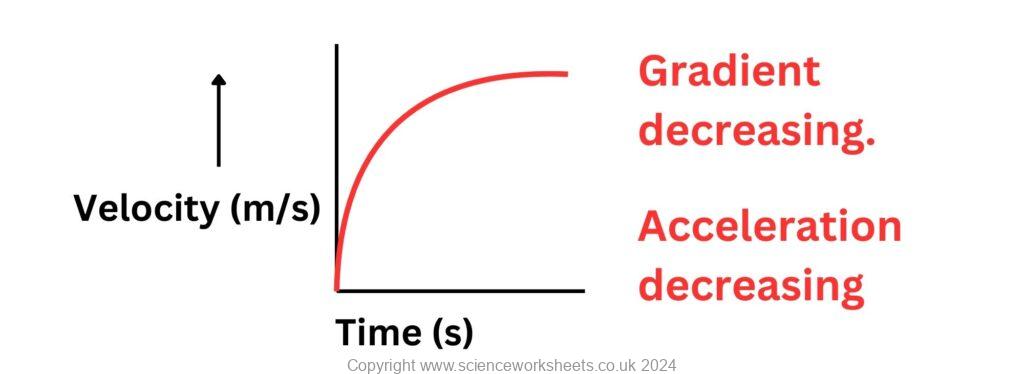
1.A car’s velocity-time graph shows a curve that starts at zero velocity and increases non-linearly over time, eventually reaching a uniform velocity. Sketch a velocity time graph to show this motion.
2. If the curve on a velocity-time graph becomes steeper over time, how would you describe the change in acceleration?
If the gradient increases over time, then the acceleration will increase over time.
3. If a curved velocity-time graph crosses the time axis, what does this indicate about the motion of the object?
If the velocity time graph line crosses the time axis, then the direction of the object changes. If the object was previously moving forwards, once the line crosses the time axis, the object will now move in the opposite direction e.g. backwards.