Answers to AQA GCSE Equation of Motion (Combined Science)
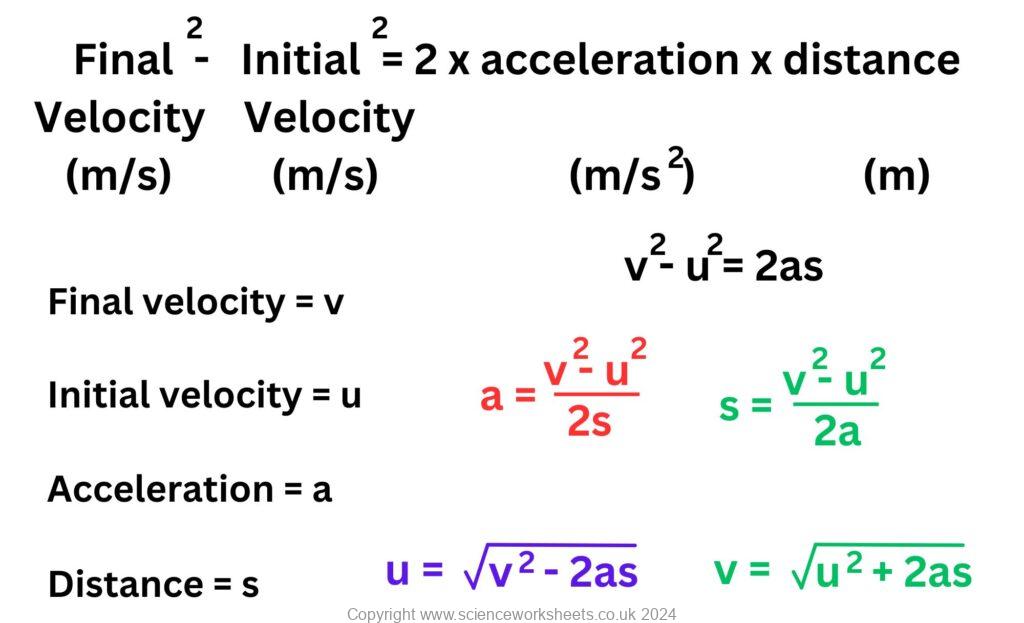
1.A football is kicked from rest and accelerates to a maximum velocity of 3m/s over a distance of 5m. Calculate the acceleration of the football.
v = 3m/s, u = 0m/s (at rest), s = 5m
a = (v2-u2)/2s
a = (32-02)/2 x 5
a = 9/10
a = 0.9m/s2
2. A train decreases its velocity from 25m/s to rest with an acceleration of -4m/s2. Calculate the distance travelled for the train to stop.
v= 0m/s(at rest), u = 25m/s, a = -4m/s2
s = (v2-u2)/2a
s = (02-252)/(2 x -4)
s = -625/-8
s = 78.1m
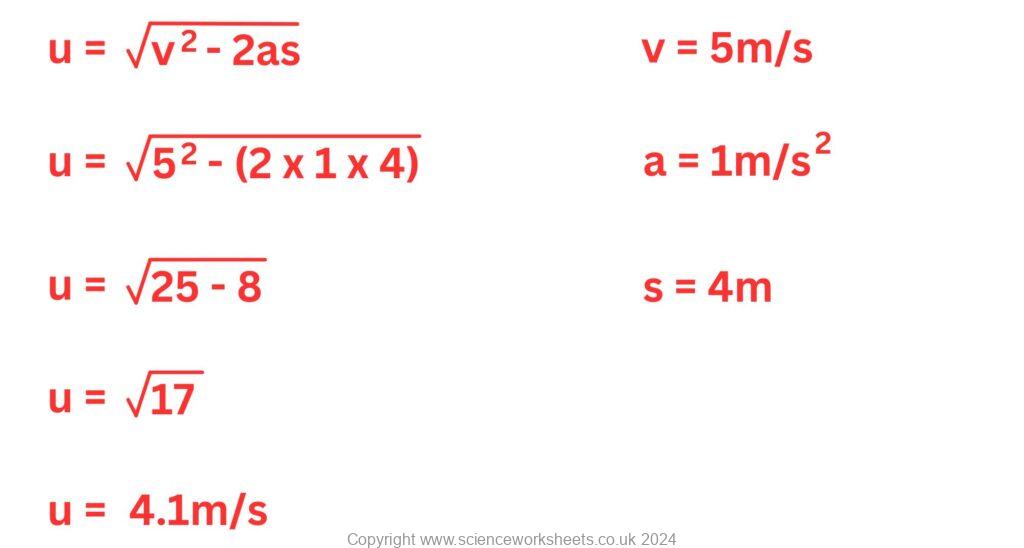
3. A cyclist reaches a velocity of 5m/s after accelerating at 1m/s2 for a distance of 4m. Calculate the initial velocity of the cyclist.
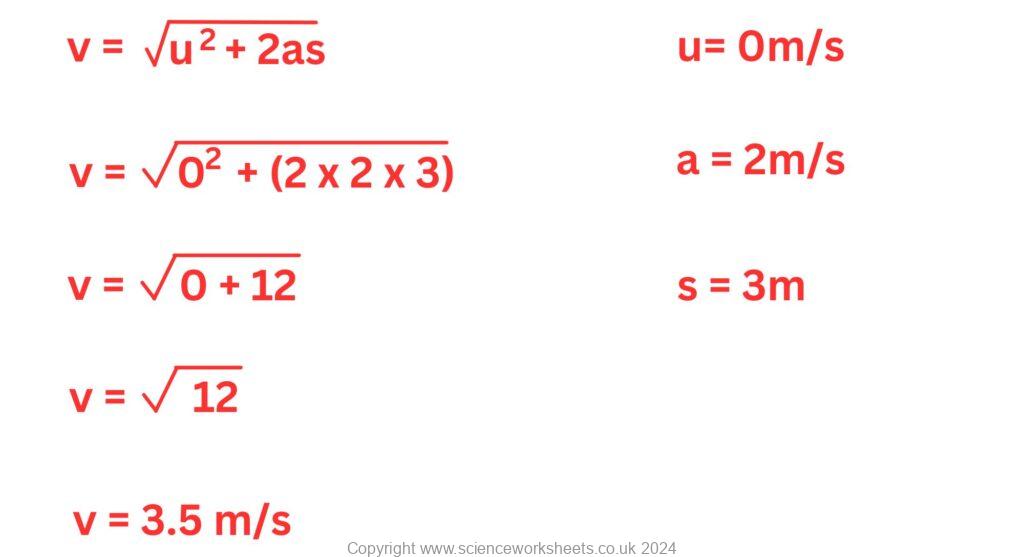
4. A lion accelerates from rest to reach a final velocity, using an acceleration of 2m/s2 over a distance of 3m. Calculate the final velocity of the lion.
Absorption and Emission of EM Radiation
JJ Thomson and Plum pudding model
Ernest Rutherford and the Nuclear Model
Niels Bohr changing the Nuclear Model
Discovering the Proton and Neutron
Measuring radiation from radioactivity
Radiation types and properties
Random nature of radioactive decay
Radioactive contamination or irradiation
Hazards of contamination and irradiation
Studies on the effects of radiation on humans