Answers to AQA GCSE Series Circuit (Combined Science)
Practice Questions
1.State the value for the current for ammeter A1 in the circuit below:
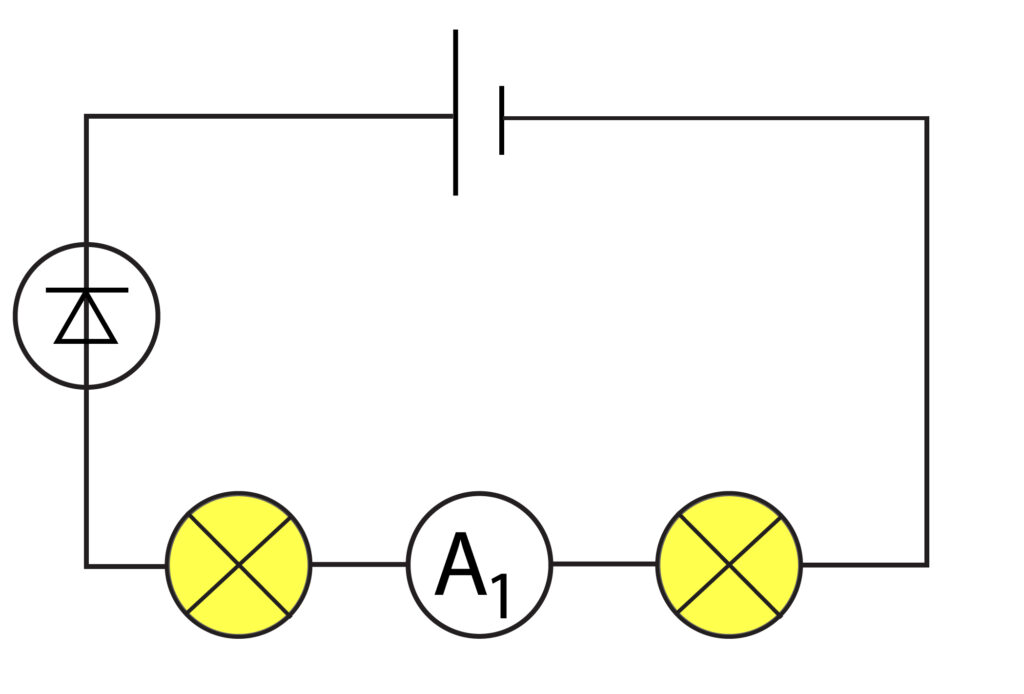
The current should flow from positive terminal of cell around to the negative, in this case the anticlockwise direction. However, the diode has been placed so that the current would have to pass through in the high resistance direction. This will mean that a current cannot flow, so the reading on A1 will be 0A.
2. Calculate the potential difference across the cell for voltmeter V1, using the cell diagram below.

In a series circuit the potential difference across the cell is shared between the components. So, total potential difference across the cell = 5V + 7V = 12V.
3. The total resistance of a series circuit is 35 ohms. There are 3 resistors in series, that each have their own resistance value in the ratio of 4:2:1. Calculate the resistance of each resistor.
Total resistance in a series circuit is the sum of the individual resistors.
If ratio is 4:2:1, then there are 4+2+1 = 7 parts in total
35/7 = 5 ohms per part
Resistor (4 part ratio) = 5 x 4 = 20 ohms
Resistor (2 part ratio) = 5 x 2 = 10 ohms
Resistor (1 part ratio) = 5 x 1 = 5 ohms
So resistance is shared 20 ohms:10 ohms:5 ohms
Absorption and Emission of EM Radiation
JJ Thomson and Plum pudding model
Ernest Rutherford and the Nuclear Model
Niels Bohr changing the Nuclear Model
Discovering the Proton and Neutron
Measuring radiation from radioactivity
Radiation types and properties
Random nature of radioactive decay
Radioactive contamination or irradiation
Hazards of contamination and irradiation
Studies on the effects of radiation on humans