AQA GCSE Role of Bile in Digestion(Biology)
Role of Bile in Digestion
Digestion is the process of breaking down large insoluble molecules into smaller soluble ones which can be absorbed into the bloodstream.
Bile is produced in the liver, stored in the gall bladder. Bile will flow down the bile duct and enter the small intestine.

Bile and neutralising excess stomach acid.
The stomach produces hydrochloric acid to kill bacteria on food and to create the optimum pH for protease enzymes. When the part digested food leaves the stomach and enters the small intestine there is residual acid that enters the small intestine.
Bile is alkaline.
This acid can damage the wall of the small intestine, so bile mixes with the food at the entrance to the small intestine to neutralise any excess stomach acid present on the food.
Bile and lipids
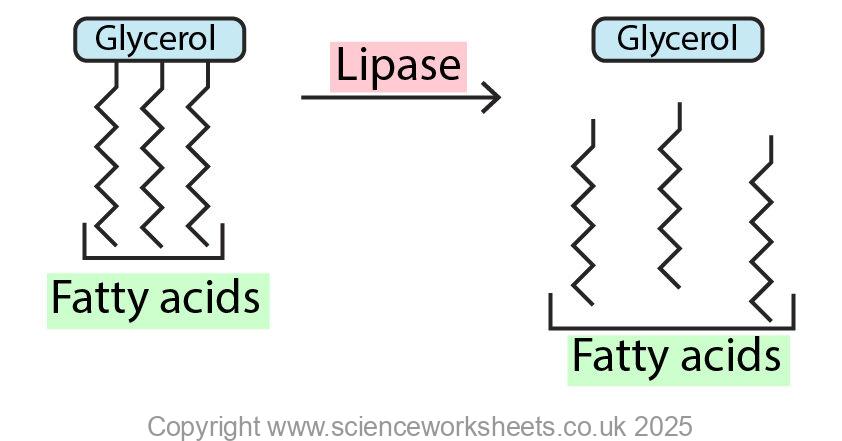
Bile will cause emulsification of lipids in the small intestine. It will disperse the large lipid globules into small lipid droplets, which have a larger surface area for the enzyme lipase to act on. This will increase the rate of fat breakdown by lipase.
(Students often think that bile chemically breaks down lipids. This is NOT correct. Before and after the action of the bile, lipid is present. Only the enzyme lipase can speed up the chemical breakdown of lipids into fatty acids and glycerol).

(Students often think that bile chemically breaks down lipids. This is NOT correct. Before and after the action of the bile, lipid is present.
Only the enzyme lipase can speed up the chemical breakdown of lipids into fatty acids and glycerol).
Practice Questions
1.State where bile is produced
2. State where bile is stored
3. What is the name of the duct that bile travels through to reach the small intestine
4. Describe how bile helps to protect the structure of the small intestine
5. Bile can help speed up the digestion of lipids. Explain how.
Factors affecting the rate of photosynthesis
Measuring & calculating rates of photosynthesis
Inverse square law and photosynthesis
Economics of enhancing the conditions in greenhouses
Investigating the effect of light intensity on the rate of photosynthesis
Data analysis and nervous system
The effect of a factor on human reaction time
Controlling blood glucose concentration
Regulating water and nitrogen levels in the body.
Hormones and human reproduction
Using hormones to treat infertility
Control and coordination in plants using hormones
Investigating the effect of light or gravity on the growth of newly germinated seedlings