AQA GCSE Reflexes & Synapses (Biology)
Reflexes
A reflex action is a rapid, automatic response to a stimulus.
It does not involve the conscious part of the brain
Reflexes are most commonly processed in the spinal cord.
A reflex action will help to protect us from danger.
Examples of reflexes:
Pulling your hand away from a hot object
Knee-jerk reflex
Reflex Arc
The reflex arc is the pathway of neurones that the impulse travels along.
Below is a flow chart to show the pathway from a stimulus to a response using a reflex arc.

Reflex arc pathway
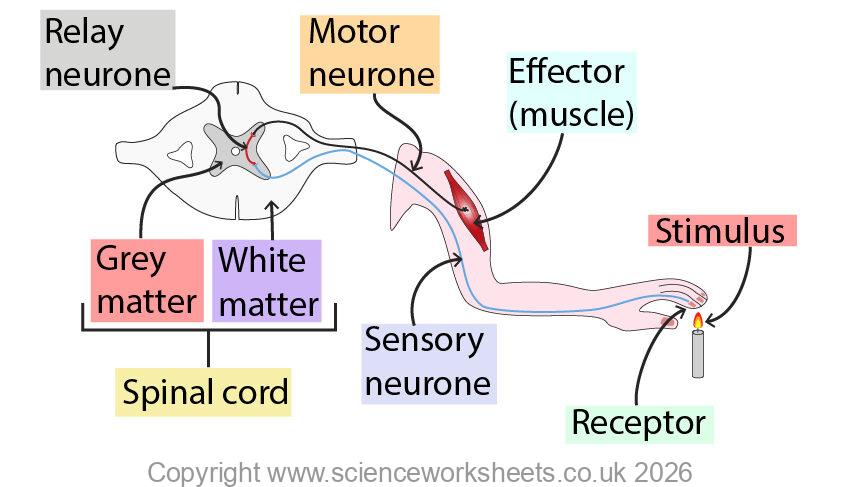
Pathway of a reflex action
Stimulus
– A change in the environment (e.g. heat from a hot object such as a candle flame)
Receptor
– Detects the stimulus (e.g. pain receptors in the skin)
Sensory neurone
– Carries electrical impulses from the receptor to the spinal cord
Relay neurone (spinal cord)
– Connects sensory neurone to motor neurone
– Allows the response to happen without conscious thought
Motor neurone
– Carries impulses from the spinal cord to the effector
Effector
– A muscle or gland. In this case a muscle will contract to move the lower arm away from the candle.
Response
– Muscle contracts or gland releases a substance (e.g. hand pulls away)
Synapse
A synapse is the gap between two neurones.
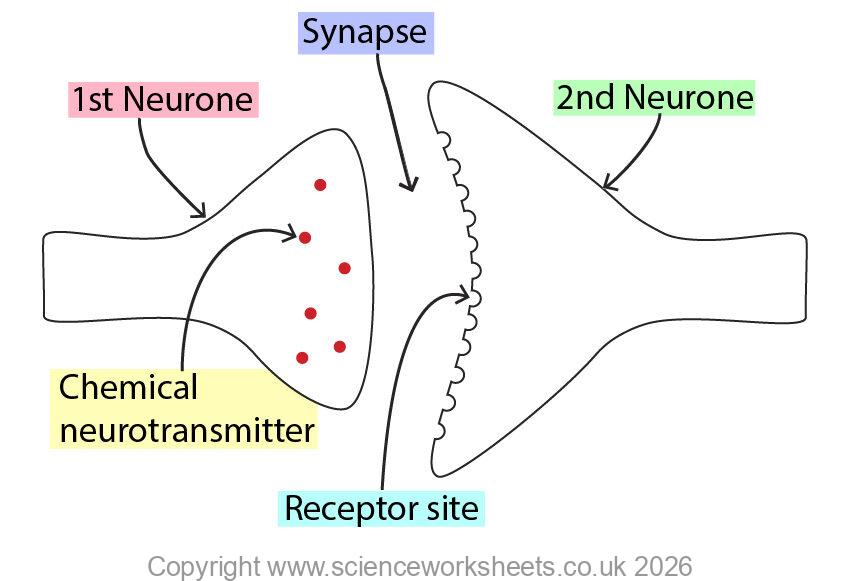
A synapse occurs between:
1.Sensory and relay neurone
2.Sensory and motor neurone
3. Relay and motor neurone
It is where a signal is passed from one neurone to another.
How a synapse works
1.An electrical impulse arrives at the end of a neurone
2.This causes chemicals (neurotransmitters) to be released
3.Neurotransmitters diffuse across the synaptic gap
4. Neurotransmitter binds to receptors on the next neurone
5. This triggers a new electrical impulse in the next neurone
See the diagram below.

Why synapses are important
Make transmission one-way because the neurotransmitter (chemical) is produced in 1st neurone and receptors are on 2nd neurone
Allow control of responses
Cause a slight delay, which helps prevent over-reaction
Are involved in reflexes and brain processing
Synapses in reflexes (link to reflex arc)
In a reflex arc, synapses occur:
Between sensory neurone → relay neurone
Between relay neurone → motor neurone
These synapses are usually in the spinal cord
Practice Questions
1.Describe what a reflex is
2.State what is meant by the term a reflex arc
3. Describe how a synapse works.
Factors affecting the rate of photosynthesis
Measuring & calculating rates of photosynthesis
Inverse square law and photosynthesis
Economics of enhancing the conditions in greenhouses
Investigating the effect of light intensity on the rate of photosynthesis
Data analysis and nervous system
The effect of a factor on human reaction time
Controlling blood glucose concentration
Regulating water and nitrogen levels in the body.
Hormones and human reproduction
Using hormones to treat infertility
Control and coordination in plants using hormones
Investigating the effect of light or gravity on the growth of newly germinated seedlings