AQA GCSE Osmosis potato mass practical(Biology)
Osmosis Potato Mass Practical.
Investigate the effect of a range of concentrations of salt or sugar solutions on the mass of plant tissue.
Apparatus
- A potato
- Cork borer
- Labels or a permanent marker
- Paper towels
- Top-pan balance accurate to at least 0.01 g
- A range of sugar or sodium chloride solutions (0.25−1.0 mol/dm3)
- Distilled water
Method
A cork borer is used to cut 5 potato cylinders of the same size.
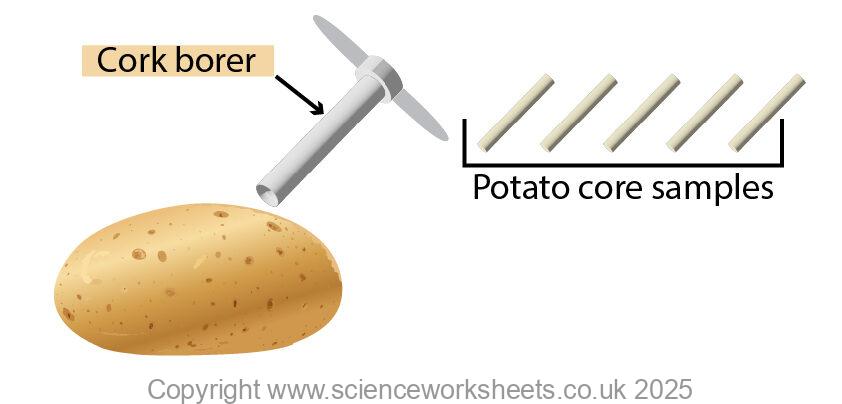
A paper towel is used to remove excess fluid from the outside of each potato core, then the initial mass of each of the potato core is recorded.

After recording the initial mass of each potato core, they were placed into sucrose solutions of different concentrations, with one core placed into distilled water as a control.
The potato cores were left for 1 hour.

After soaking for 1 hour, the potato cores are removed from the solutions. Excess surface liquid is gently blotted away with a paper towel, and the mass of each core is then recorded again.
Data is recorded in the table below
| Tube | Sucrose concentration (mol/dm3) | Initial mass of potato core (g) | Final mass of potato core (g) | Change in mass of potato core (g) | Percentage change in mass |
|---|---|---|---|---|---|
| 1 | 0.00 (Distilled water) | 10.00 | 10.55 | +0.55 | +5.50 |
| 2 | 0.25 | 10.00 | 10.02 | +0.02 | +0.20 |
| 3 | 0.50 | 10.00 | 9.65 | -0.35 | -3.50 |
| 4 | 0.75 | 10.00 | 9.36 | -0.64 | -6.40 |
| 5 | 1.00 | 10.00 | 9.10 | -0.90 | -9.00 |
Calculating Percentage change
In the table above, percentage change is calculated using the following formula:

Analysis of raw data
A graph is now plotted of Percentage change (Y axis) against sucrose concentration (X axis).

In our case, the concentration of the potato cells is about 0.26 mol/dm3.
When the potato cells are placed in solution <0.26 mol/dm3 water moves into the cells by osmosis, so they gain mass.
When potato cells are placed in a solution equal to 0.26mol/dm3, water doesn’t move into or out of cells by osmosis, so mass is constant.
When the potato cells are placed into a solution greater than 0.26 mol/dm3, water moves out of the cells by osmosis, so they lose mass.
Practice Question
1.What is the purpose of the cork borer?
2. State the formula for percentage change
3. Using a percentage change in mass vs concentration graph. Explain how we can estimate the concentration of the potato cells.
Factors affecting the rate of photosynthesis
Measuring & calculating rates of photosynthesis
Inverse square law and photosynthesis
Economics of enhancing the conditions in greenhouses
Investigating the effect of light intensity on the rate of photosynthesis
Data analysis and nervous system
The effect of a factor on human reaction time
Controlling blood glucose concentration
Regulating water and nitrogen levels in the body.
Hormones and human reproduction
Using hormones to treat infertility
Control and coordination in plants using hormones
Investigating the effect of light or gravity on the growth of newly germinated seedlings