AQA GCSE Osmosis (Biology)
Osmosis.
Osmosis is the diffusion of water molecules from a dilute solution to a concentrated solution through a partially permeable membrane.
Osmosis allows water molecules to cross cell membranes, so water can enter or leave cells.
A solute is a dissolved solid such as glucose or sucrose.
Partially permeable membrane has holes that are large enough to let the water molecules pass, but too small to let the solute molecules pass.
A dilute solution has a high concentration of water and a low concentration of solute.
A concentrated solution has a low concentration of water, high concentration of solute.

In the above diagram, water molecules will have a net movement from the left hand side where there is a dilute solution to the right hand side where there is a concentrated solution.
How osmosis works
Only water molecules can cross the partially permeable membrane. This is because the water molecules are small enough to move through the holes, but the solute molecules are too large.
At room temperature, the molecules have kinetic energy, moving in random directions so the water molecules spread themselves out from a dilute solution to a concentrated solution over time.
Examples of osmosis
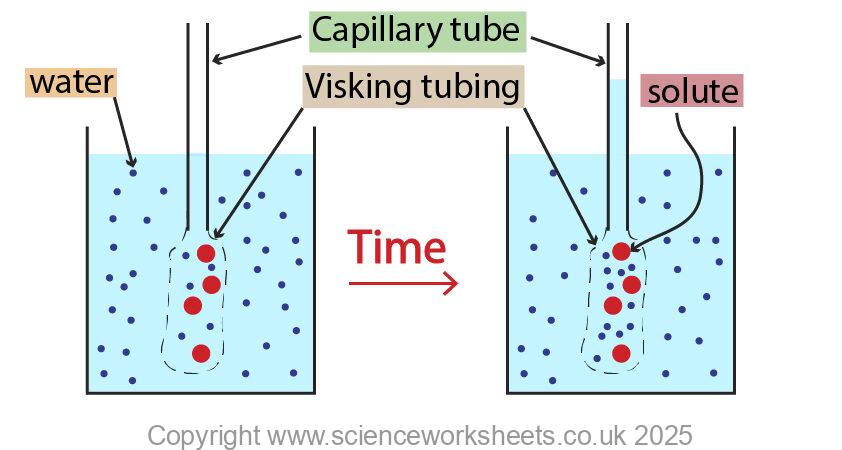
Visking tubing can be used as an artificial partially permeable membrane for osmosis experiments.
Water will move by osmosis from the beaker into the visking tubing. This is because the visking tubing contains a concentrated solution, the water around the visking tubing is a dilute solution as it does not contain solute.
As a result the water level in the capillary tube rises! Compare the water levels in the capillary tube on the left to the tube on the right.
Osmosis in animal cells.
Animal cells can be placed into a hypotonic solution, isotonic solution or hypertonic solution.
When placed into:
A hypotonic solution is a dilute solution, so water will move into the red blood cell by osmosis. Animal cells do not have a cell wall, so they will swell up and burst!
An isotonic solution has the same concentration as the red blood cell. So the rate of water entering the cell by osmosis, is equal to the rate of water leaving by osmosis. As a result the cell stays the same size.
A hypertonic solution is where the solution is more concentrated than the cell. As a result water will move out of the cell by osmosis, cell will shrivel up.

Osmosis in plant cells
Plant cells can be placed into a hypotonic solution, isotonic solution or hypertonic solution.
When placed into:
A hypotonic solution is a dilute solution, so water will move into the plant cell by osmosis. Plant cells have a cell wall, so they will swell up and become turgid.
An isotonic solution has the same concentration as the plant cell. So the rate of water entering the cell by osmosis, is equal to the rate of water leaving by osmosis. As a result the cell stays the same size. The cell is referred to as being flaccid.
A hypertonic solution is where the solution is more concentrated than the cell. As a result water will move out of the cell by osmosis, cell membrane will pull away from the cell wall. The cell is referred to as being plasmolysed.

Practice Question
1.Define the term osmosis
2. Explain what is meant by a partially permable membrane
3. Explain the difference between a dilute solution and a concentrated solution
4. A piece of potato is placed into salty water. After 1 hour it has shrunk is size. Explain why.
Factors affecting the rate of photosynthesis
Measuring & calculating rates of photosynthesis
Inverse square law and photosynthesis
Economics of enhancing the conditions in greenhouses
Investigating the effect of light intensity on the rate of photosynthesis
Data analysis and nervous system
The effect of a factor on human reaction time
Controlling blood glucose concentration
Regulating water and nitrogen levels in the body.
Hormones and human reproduction
Using hormones to treat infertility
Control and coordination in plants using hormones
Investigating the effect of light or gravity on the growth of newly germinated seedlings