AQA GCSE Microscopes(Biology)
Microscopes
Development of Microscopy
Magnification = how much bigger the image is compared to the object.
Resolution = how clearly two points can be distinguished as separate.
Light microscopes (first used in the 1600s):
Use light and glass lenses to form an image.
Allowed scientists like Robert Hooke and Antonie van Leeuwenhoek to see and draw cells for the first time.
Limited in detail because of their lower magnification (about ×1,500–×2,000) and lower resolution (about 200 nanometres).
Electron microscopes (developed in the 1930s):
Use beams of electrons instead of light.
Two main types: Transmission electron microscopes (TEMs) and Scanning electron microscopes (SEMs).
Much higher magnification (over ×2,000,000) and higher resolution (less than 1 nanometre).
How Electron Microscopy Increased Understanding
With greater magnification and resolution, electron microscopes can reveal the detailed structures inside cells.
Scientists could now see:
The internal structure of mitochondria and chloroplasts.
Ribosomes, membranes, and viruses (not visible with light microscopes).
This has led to a much deeper understanding of how cells function.
Summary:
Electron microscopes have higher magnification and much higher resolution than light microscopes, so we can study sub-cellular structures in detail.
Converting units
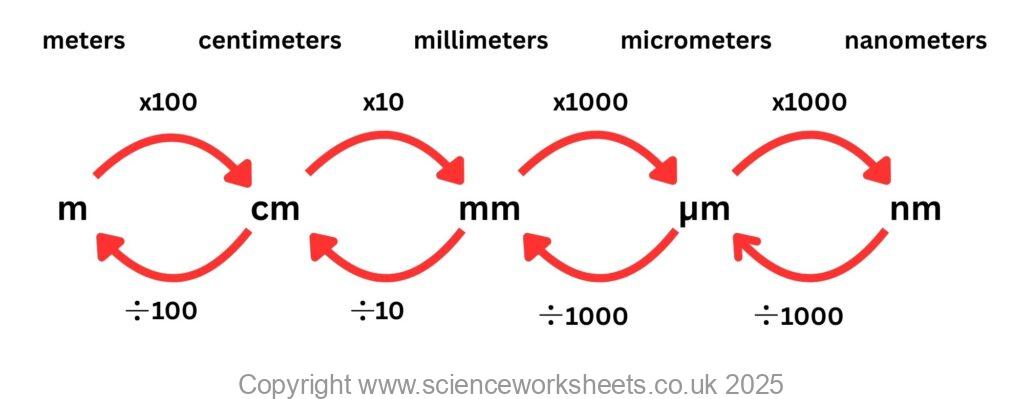
You will need to be able to convert different units, the diagram below will help you.
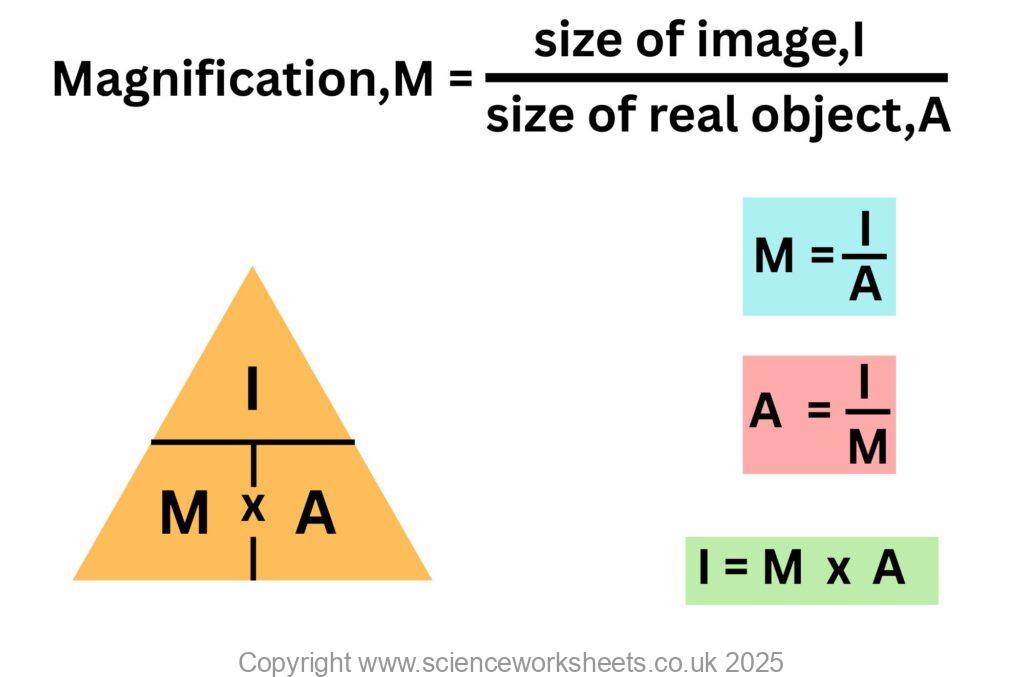
Magnification calculations
Example question
An animal cell has a diameter of 30μm. When the diameter of the cell was measured using a ruler on a piece of paper it was 3cm.
Calculate the magnification.
Real size = 30μm (size of object in real life)
Image size = 3cm(size of object when measured with ruler)
Using the conversion above
3cm = 30mm = 30000μm for the image size of the cell on the paper.
Magnification = image size/real object size
Magnification =30000/30 = x1000 for magnification
Practice Question
1.Define the term magnification
2.Define the term resolution
3. Explain how the development of electron microscopes have allowed us to advance our understanding of cell structure.
4. A bacterial cell has a diameter of 1μm. When drawn on a piece of paper it is 4cm. Calculate the magnification of the image.
Factors affecting the rate of photosynthesis
Measuring & calculating rates of photosynthesis
Inverse square law and photosynthesis
Economics of enhancing the conditions in greenhouses
Investigating the effect of light intensity on the rate of photosynthesis
Data analysis and nervous system
The effect of a factor on human reaction time
Controlling blood glucose concentration
Regulating water and nitrogen levels in the body.
Hormones and human reproduction
Using hormones to treat infertility
Control and coordination in plants using hormones
Investigating the effect of light or gravity on the growth of newly germinated seedlings