AQA GCSE Microorganism cultures (Biology)
Microorganism Cultures
Bacteria are a type of microorganism. Bacteria divide by a process called binary fission.
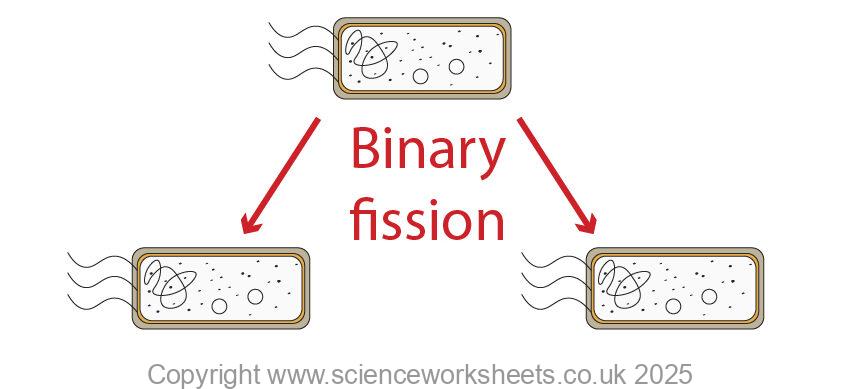
Conditions for culturing microorganisms.
Bacteria are grown in a nutrient broth solution or as colonies on an agar gel plate in a lab.
In order for a bacterial population to grow, they need nutrients such as protein and carbohydrates.
Warmer temperatures increase population growth.
However, school and college labs are not allowed to incubate bacterial populations at temperatures about 25⁰C . Temperatures above 25⁰C are more likely to encourage the replication of pathogenic bacteria.
Under ideal conditions of warm temperature and good supply of nutrients the bacterial population can double, once every 20 minutes.
Preparation of an uncontaminated culture using aseptic technique
Aseptic conditions means that the conditions are sterile and there is no contamination present from other microorganisms.
If other microorganisms are present they could compete for nutrients with the ones that you are trying to culture. They could also be pathogenic and cause us harm.
The following steps are taken to ensure aseptic conditions:
1.A bunsen burner with a blue flame is used to create a sterile zone. The area around the Bunsen burner where the rising convection currents help keep airborne microbes and dust away from your work.

2. The agar or broth medium along with the petri dishes all need to be sterilised prior to use.
Sterilisation of the agar or broth is done using an autoclave. This uses high pressure steam at 121⁰C to kill any bacteria.
Glass petri dishes can also be autoclaved for sterilisation, plastic petri dishes are sterilised using UV light.
Agar or nutrient broth CANNOT be sterilised using UV light as it will not penetrate them.
See the image below.

3. A metal inoculating loop is sterilised by holding it in a blue bunsen flame until it is red hot. It is then allowed to cool in air before the next stage.
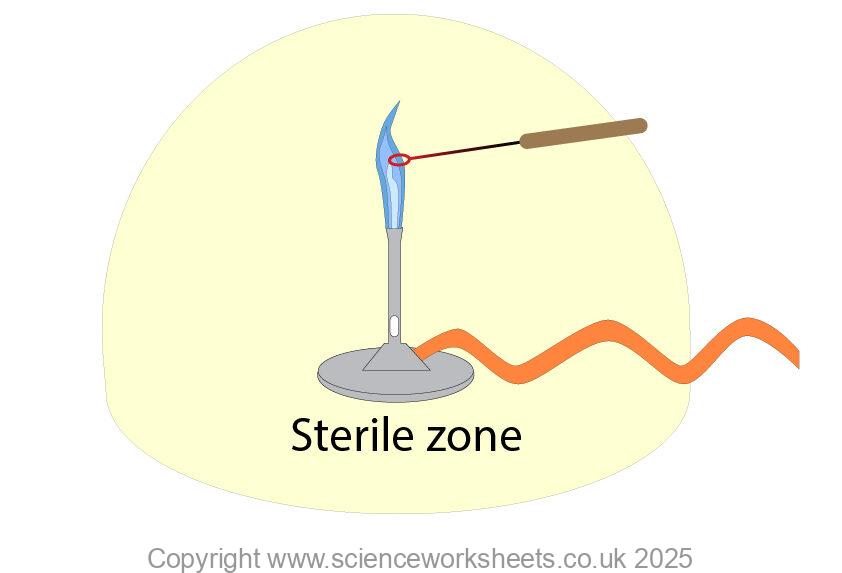
4. The cool sterilised loop is dipped into a suspension of microbes and then streaked across the surface of the agar in a petri dish. The lid of the dish should be left ajar to try to keep the area sterile whilst streaking. Remember to keep working within the sterile zone of the bunsen flame!

5. After streaking, the lid of the petri dish is fixed in place with two pieces of tape. It is important not to completely seal all around the dish. This is to allow oxygen to enter the petri dish. If oxygen cannot enter, it will increase the chance of anaerobic bacteria growing which are more likely to be pathogenic!

6. The dish should then be incubated at 25⁰C upside down. Upside down prevents condensation falling on the agar.
Higher temperatures are used in industry or hospitals. In schools and colleges the maximum is 25⁰C to reduce risk of pathogenic bacteria growing.

Practice Question
1.State the name of the process that bacteria use to divide
2.Explain what is meant by the term aseptic techniques.
3. Schools will not culture bacteria at temperatures greater than 25⁰C. Explain why.
Factors affecting the rate of photosynthesis
Measuring & calculating rates of photosynthesis
Inverse square law and photosynthesis
Economics of enhancing the conditions in greenhouses
Investigating the effect of light intensity on the rate of photosynthesis
Data analysis and nervous system
The effect of a factor on human reaction time
Controlling blood glucose concentration
Regulating water and nitrogen levels in the body.
Hormones and human reproduction
Using hormones to treat infertility
Control and coordination in plants using hormones
Investigating the effect of light or gravity on the growth of newly germinated seedlings