AQA GCSE Enzyme Rate Calculations(Biology)
Enzymes Rate Calculations
You need to be able to calculate rate of reaction for enzyme based reactions.
Rate of reaction is the amount of product formed per unit time, or the amount of substrate used up per unit time.

How this links to enzymes.
In enzyme experiments, this might involve:
Measuring how quickly a substrate is broken down, e.g. starch → maltose (using amylase and iodine test).
Measuring how fast a product forms, e.g. oxygen from hydrogen peroxide (catalase reaction).
You might compare rates at different temperatures, pH levels, or enzyme concentrations.
Obtaining the rate from a graph
Catalase is an enzyme found in liver tissue, it can break down hydrogen peroxide into water and oxygen.
To monitor the rate, the volume of oxygen produced over time is recorded.
The data recorded is then used to construct the graph below.

We need to draw a tangent to the line, where we want to calculate the rate. The tangent should be as long as possible and just touch the line.
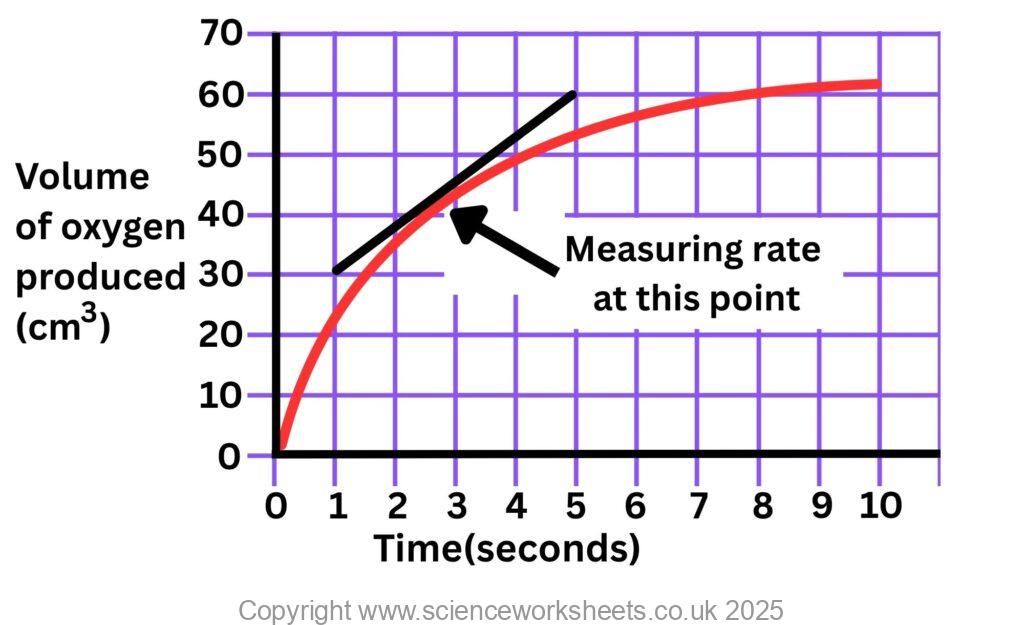
Form a triangle around the tangent. Measure the change in volume of oxygen. Measure the change in time.

Using the following formula

Practice Questions
1. Catalase reacting with hydrogen peroxide will produce 60cm3 of oxygen gas in 90 seconds. Calculate the rate of reaction in cm3/s
2.Use the graph below to answer the following question

2a. Draw a tangent to the line, calculate the rate at 5 seconds
2b. Describe how the rate changes as time increases
Factors affecting the rate of photosynthesis
Measuring & calculating rates of photosynthesis
Inverse square law and photosynthesis
Economics of enhancing the conditions in greenhouses
Investigating the effect of light intensity on the rate of photosynthesis
Data analysis and nervous system
The effect of a factor on human reaction time
Controlling blood glucose concentration
Regulating water and nitrogen levels in the body.
Hormones and human reproduction
Using hormones to treat infertility
Control and coordination in plants using hormones
Investigating the effect of light or gravity on the growth of newly germinated seedlings