AQA GCSE Enzymes(Biology)
Enzymes
Enzymes are protein molecules that act as biological catalysts, so they speed up chemical reactions.
Metabolism is the sum of all the chemical reactions in a cell or body of an organism. Enzymes speed up chemical reactions so they are fast enough to sustain life.
Each enzyme will catalyse a specific reaction.
The working part of an enzyme is its active site. The shape of the active site is complementary to that of the substrate (reactant). So, only this substrate is able to enter and bind to the active site.
The enzyme amylase will catalyse the breakdown of starch into sugars. Other substrates such as protein or lipids will not fit into the active site.
In the diagram below, starch has hexagon structure and can bind to the active site of the enzyme. Whilst the protein has as circular shape and it will not fit into the hexagon active site.

Lock and Key theory
The model that is used to represent enzyme action is known as the lock and key model. In this model, the active site of the enzyme is a lock and the substrate is a key.
Each enzyme has an active site, which the substrate (reactant) will enter and bind to forming an enzyme-substrate complex.
A chemical reaction then occur, resulting in the formation of a product, which leaves the active site of the enzyme.

Factors that affect enzymes
Enzymes are affected by changes to
1.Temperature
2.pH
Temperature and Enzymes
Using the diagram below:
From A to B as temperature increases, rate of enzyme reaction will increase. This is because at higher temperatures the molecules have more kinetic energy, so they move faster, there are more collisions per unit time. It is more likely that an enzyme substrate complex will form, so rate of reaction will increase.
At B, this is the maximum rate, this point is known as the optimum temperature. So, it is the temperature, which has the highest rate of reaction. Different enzymes have different optimum temperatures.
From B to C as temperature increases the rate of reaction will decrease. This is because the enzyme becomes denatured. The high temperatures change the shape of the active site and the substrate cannot enter the active site, so the reaction cannot be catalysed.

pH and Enzymes
pH is a measure of how acidic or alkaline a solution is.
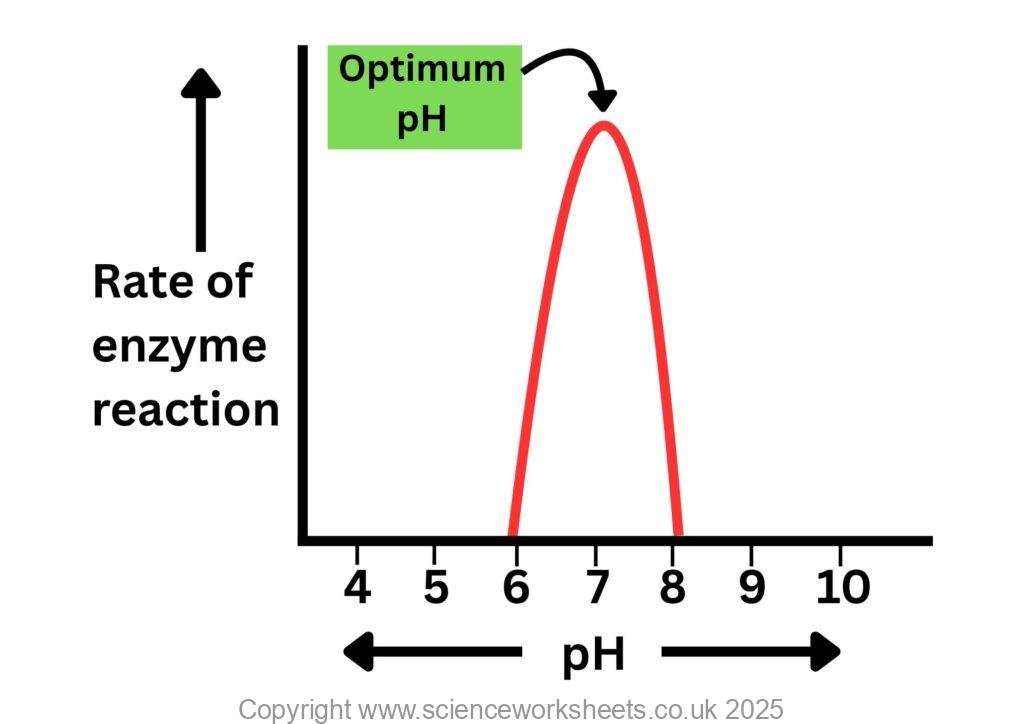
Each enzyme has an optimum pH, this is where it has the maximum rate of reaction.
Below or above the optimum pH the rate of enzyme action will decrease. This is because changing the pH will change the shape of the active site, so the substrate can no longer enter and bind to the active site. At extremes of pH, the enzyme is denatured.
Enzymes and Metabolism.
Metabolism is the sum of all the chemical reactions in a cell or body of an organism.
Enzymes are biological catalysts that can increase the speed of these reactions.
In an organism, metabolic reactions need to happen quickly enough to sustain life. Enzymes are essential to speed up the metabolic reactions so they occur quickly enough to sustain life. Without enzymes reactions would be too slow and the organism would die.
Enzymes speed up two main types of metabolic reactions
1.Anabolism-Combining small molecules to form a larger molecule
2.Catabolism -Breaking down a large molecule into smaller ones
| Anabolism | Catabolism |
|---|---|
| Photosynthesis where carbon dioxide and water are combined to form glucose and oxygen. | Digestion where large insoluble molecules are broken down into smaller soluble molecules. E.g. starch into sugars. |
| Protein synthesis, where amino acids are joined together to form proteins. | Respiration where glucose and oxygen react to form carbon dioxide and water, releasing energy. |
Practice Questions
1.Describe the role of enzymes
2.Explain how the lock and key model works
3. Define the term metabolism
4. Why are enzymes essential to life?
Factors affecting the rate of photosynthesis
Measuring & calculating rates of photosynthesis
Inverse square law and photosynthesis
Economics of enhancing the conditions in greenhouses
Investigating the effect of light intensity on the rate of photosynthesis
Data analysis and nervous system
The effect of a factor on human reaction time
Controlling blood glucose concentration
Regulating water and nitrogen levels in the body.
Hormones and human reproduction
Using hormones to treat infertility
Control and coordination in plants using hormones
Investigating the effect of light or gravity on the growth of newly germinated seedlings