AQA GCSE Digestion(Biology)
Digestion
Digestion is the process of breaking down large insoluble food molecules into smaller soluble ones.
Following digestion, the broken down nutrients are absorbed into the blood, using villi which are in the small intestine.
Digestive System
The digestive system is an example of an organ system in which several organs work together to digest and absorb food.
The digestive system is made up of the alimentary canal (gut) plus accessory organs.
Alimentary canal (the tube food passes through):
-
Mouth
-
Oesophagus (food pipe)
-
Stomach
-
Small intestine (duodenum, jejunum, ileum)
-
Large intestine (colon and rectum)
-
Anus
Accessory organs (food doesn’t pass through them, but they help with digestion):
-
Salivary glands (make saliva with amylase)
-
Liver (produces bile)
-
Gallbladder (stores bile)
-
Pancreas (produces digestive enzymes and alkaline juice)
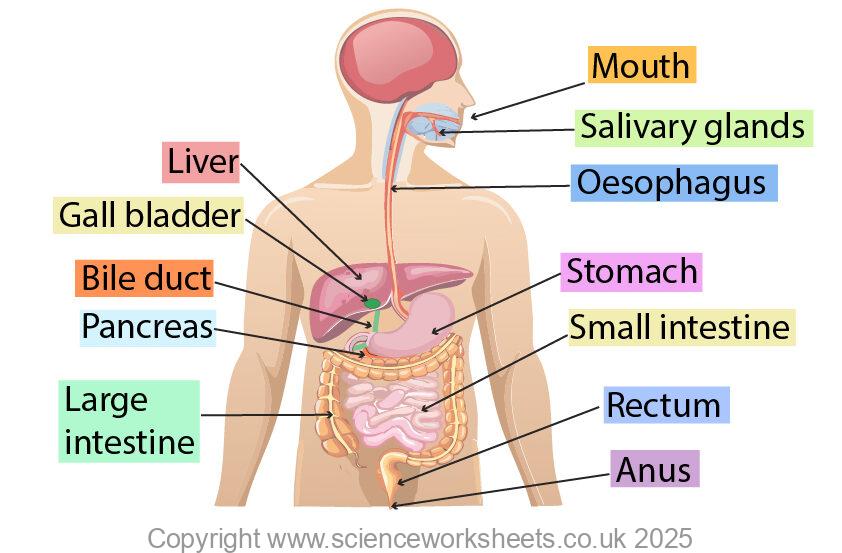
| Part of digestive system | Role in digestion |
|---|---|
| Mouth | Teeth chew the food in mechanical digestion to break the food up into smaller pieces. This makes the food easier to swallow and increases the surface area for enzymes to act on. |
| Salivary glands | Secrete saliva into the mouth. Saliva contains the enzyme amylase which breaks down starch into sugars. |
| Oesophagus | Oesophagus is a muscular tube that connects the mouth to the stomach. The wall of the oesophagus contracts behind the food to force the food downwards towards the stomach. These muscular contractions are called peristalsis. |
| Stomach | Wall of the stomach contains muscle which contracts to churn the food mechanically breaking it up into smaller pieces to increase the surface area. Stomach also produces protease enzymes which breaks down protein into amino acids. Hydrochloric acid is secreted by the stomach to kill bacteria on the food, preventing food poisoning and also provides the optimum pH for protease enzymes. |
| Liver & Gall bladder | Liver produces bile, whilst the gall bladder stores bile. Bile will emusify fats, this means it disperses large globules of fat into smaller droplets of fat, which have a larger surface area for the enzyme lipase to act on. Bile will flow from gall bladder, down bile duct into the small intestine. |
| Pancreas | Produces carbohydrase enzymes such as amylase. Pancreas also produces lipase and protease. All of these enzymes flow from pancreas, through pancreatic duct into the small intestine. |
| Small intestine | Produces Protease and lipase enzymes. Protease breaks down protein into amino acids. Lipase breaks down lipids (fats) into fatty acids and glycerol. Digestion of the food is completed in the small intestine. The nutrients are absorbed into the blood by villi which line the small intestine. |
| Large intestine | Absorbs water from the remains of the food. The remains form faeces, which is stored in the rectum, before being passed out through the anus in the process of egestion. |
Practice Questions
1.Define the term digestion
2.Which organ produces bile?
3.Name the organ that connects the mouth to the stomach.
4.Explain how different organs of the digestive system work together to break down food and absorb the products of digestion. In your answer, refer to enzymes and physical adaptations.
Factors affecting the rate of photosynthesis
Measuring & calculating rates of photosynthesis
Inverse square law and photosynthesis
Economics of enhancing the conditions in greenhouses
Investigating the effect of light intensity on the rate of photosynthesis
Data analysis and nervous system
The effect of a factor on human reaction time
Controlling blood glucose concentration
Regulating water and nitrogen levels in the body.
Hormones and human reproduction
Using hormones to treat infertility
Control and coordination in plants using hormones
Investigating the effect of light or gravity on the growth of newly germinated seedlings