AQA GCSE Cells, Tissues, Organs and Organ Systems(Biology)
Cells
Cells are the basic building blocks of all living organisms.
There are different types of cells:

Tissues
A tissue is a group of cells with a similar structure and function.
Both plants and animals contain tissues.
Animal tissue
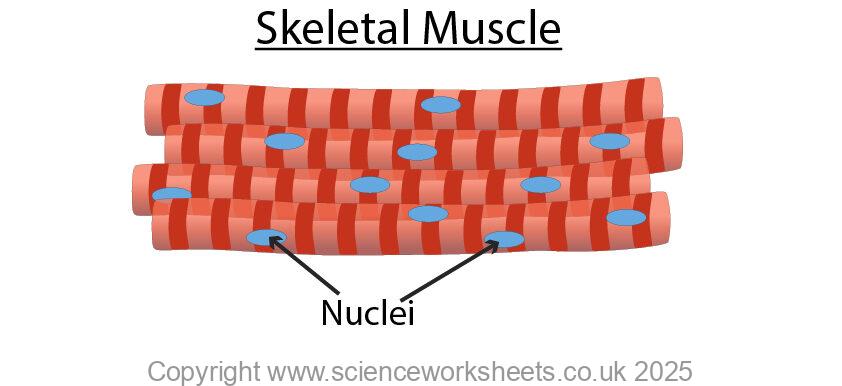
For example: muscle tissue. Muscle tissue is made up of many muscle cells working together. Below is an image showing skeletal muscle tissue.
Plant tissue
An example of plant tissue is phloem tissue. Phloem tissue is used for transporting sugars throughout the plant.

Organs
An organ is a group of tissues working together to carry out a specific function.
Both plants and animals contain organs
Animal Organs

Heart
| Tissue | Function |
|---|---|
| Muscle tissue | Contracts to pump blood |
| Nerve tissue | Controls the heart beat |
| Epithelial tissue | lines the inside of chambers and outside of heart |
| Connective tissue | Holds everything together |
Stomach
| Tissue | Function |
|---|---|
| Muscle | Contracts to churn food |
| Glandular tissue | Produces digestive juices e.g. enzymes and hydrochloric acid |
| Epithelial tissue | Covers the inside and outside of the stomach |
The Lungs
| Tissue | Function |
|---|---|
| Epithelial tissue | Lines the alveoli (air sacs) |
| Muscle tissue | In the bronchi or bronchioles to control air flow |
| Elastic tissue | Helps recoil of alevoli |
Small Intestine
| Tissue | Function |
|---|---|
| Muscle tissue | Contracts to move food along by peristalsis |
| Glandular tissues | Secretes enzymes to breakdown the food molecules |
| Epithelial tissue | On villi to line the intestine and help absorb nutrients |
Plant Organs
An example of a plant organ is a leaf. This contains many different tissues such as phloem, xylem, mesophyll and epidermal tissue as shown below.

Organ Systems
An organ system contains organs working together to carry out a function for an organism
An organism is made up of various organ systems.
Organ Systems in Animals
| Organ System | Contains the organs | Function |
|---|---|---|
| Digestive system | Mouth, oesophagus, stomach, small intestine, large intestine, liver and pancreas | Breaks down food, absorbs nutrients and removes undigested waste |
| Respiratory system | Lungs, trachea, bronchi, alveoli and diaphragm | Gas exchange to take in oxygen and remove carbon dioxide |
| Circulatory system | Heart, blood vessels, blood | Transports oxygen, nutrients, hormones and removes waste products |
| Nervous system | Brain, spinal cord, nerves | Detects stimuli, processes information and coordinates responses |
Organ systems in plants
The whole body of a plant is an organ system. The body of the plant contains the organs leaves, stem, roots and sometimes flowers.

Practice Questions
1. Define the term cell
2.Define the term tissue
3.Define the term organ
4. Would you classify skin as a tissue or organ?
Factors affecting the rate of photosynthesis
Measuring & calculating rates of photosynthesis
Inverse square law and photosynthesis
Economics of enhancing the conditions in greenhouses
Investigating the effect of light intensity on the rate of photosynthesis
Data analysis and nervous system
The effect of a factor on human reaction time
Controlling blood glucose concentration
Regulating water and nitrogen levels in the body.
Hormones and human reproduction
Using hormones to treat infertility
Control and coordination in plants using hormones
Investigating the effect of light or gravity on the growth of newly germinated seedlings