AQA GCSE Advantages and Drawbacks of Sexual and Asexual reproduction(Biology)
Advantages and Drawbacks of Sexual and Asexual reproduction
Sexual reproduction
Sexual reproduction is the fusion of male and female gametes.
| Advantages of sexual reproduction | Disadvantages of sexual reproduction |
|---|---|
| Source of genetic variation | Needs two parents |
| If the environment changes, variation in the population means some individuals have traits that give them a survival advantage. These individuals are more likely to survive and reproduce, which is natural selection. | Takes more time, so its slower |
| Natural selection can be speeded up by humans in selective breeding to increase food production. This means humans can use the principles of natural selection to get useful traits faster. | Must find a mate. |
| Uses more energy. |
The diagram below shows a family, where you can see variation within the family due to sexual reproduction.

Asexual reproduction
Asexual reproduction is a type of reproduction that involves only one parent and produces offspring that are genetically identical to the parent (clones).
| Advantages of asexual reproduction | Disadvantages of asexual reproduction |
|---|---|
| Only one parent needed | No genetic variation |
| Faster reproduction | If the environment changes the organisms may not be able to adapt and they may die out |
| Many genetically identical offspring can be produced when conditions are favourable. This allows an organism to colonise a new habitat. | |
| More time and energy efficient as do not need to find a mate |
Organisms That Use Both Methods
Some organisms use both sexual and asexual reproduction.Depending on the environmental conditions, they may choose one method in preference to another.
Malarial parasites
Asexual reproduction in humans
Sexual reproduction in mosquito

Fungi
When environmental conditions are good fungi will reproduce asexually to produce spores, which will then germinate to grow into a new fungus.
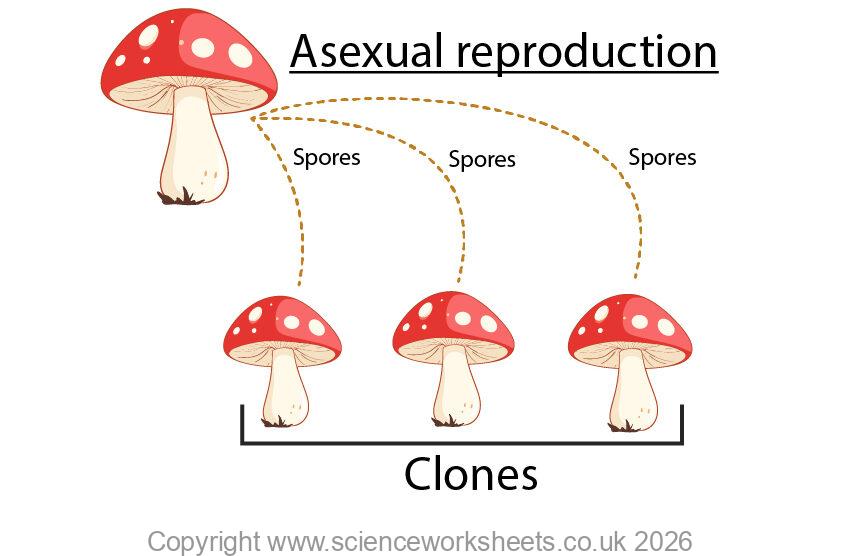
Fungi can also reproduce sexually to increase variation if the environmental conditions are not ideal. This will increase the chance of survival.
Each parent fungus produces spores, which develop into hyphae (fungal threads). These hyphae will fuse in fertilisation to form fungi with variation.

Plants
Many plants will reproduce sexually.
Strawberry plants
Strawberry plants can reproduce sexually, by pollination of flowers to produce strawberries with seeds.
However, they can also reproduce asexually, by forming runners as shown below.

Daffodils and Bulb division
Bulb division is when a plant produces new bulbs underground.
Each new bulb grows into a genetically identical plant (clone).
An example is: daffodils.

Practice Questions
1.Give two advantages of asexual reproduction
2.Give two advantages of sexual reproduction.
3.A population of bacteria reproduces asexually. Explain why this is an advantage in a stable environment.
Factors affecting the rate of photosynthesis
Measuring & calculating rates of photosynthesis
Inverse square law and photosynthesis
Economics of enhancing the conditions in greenhouses
Investigating the effect of light intensity on the rate of photosynthesis
Data analysis and nervous system
The effect of a factor on human reaction time
Controlling blood glucose concentration
Regulating water and nitrogen levels in the body.
Hormones and human reproduction
Using hormones to treat infertility
Control and coordination in plants using hormones
Investigating the effect of light or gravity on the growth of newly germinated seedlings