AQA GCSE Triplet code & protein synthesis(Biology)
Triplet code & protein synthesis
DNA stores genetic instructions in all living organisms.
A gene is a short length of DNA that codes for a protein.
Proteins do important jobs: enzymes, hormones, structural components (like collagen).

DNA Code: How It Works
DNA is made of four bases: A, T, C, G.
Every 3 bases on one of the strands of DNA will code for 1 amino acid. This is known as the triplet code.
You will need slightly more detail than this, but this will be covered in the protein synthesis section below.
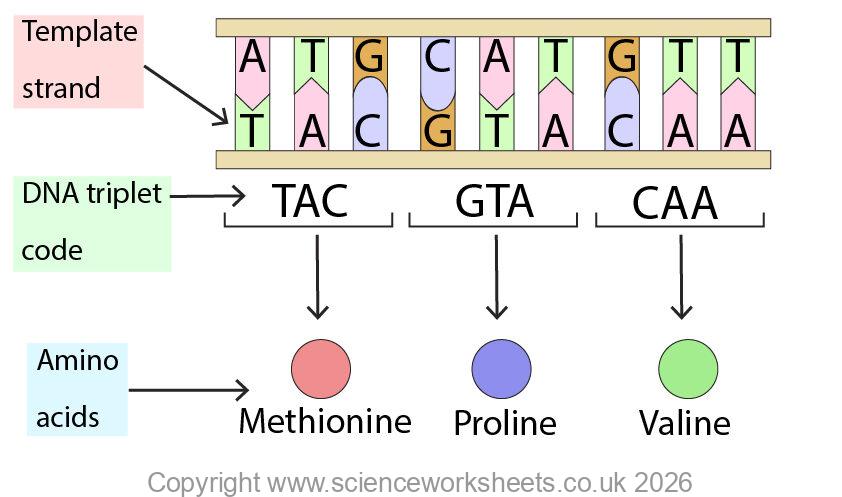
Protein Synthesis
This is made up of two main stages:
1.Transcription (occurs in nucleus)
2. Translation (occurs in cytoplasm at the ribosome).
Transcription
A section of DNA within a chromosome, known as a gene is used to produce a template molecule(also known as mRNA).
Once the template molecule is complete, it will leave the nucleus via the nuclear pore and enter the cytoplasm.
Stage 1 – The DNA is in the nucleus
Stage 2 The gene (part of DNA) unwinds, the template molecule shown in red is produced, using one of DNA strands
Stage 3 The DNA winds back up and the template molecule leaves the nucleus via the nuclear pore.

Translation
Proteins are synthesised on ribosomes, according to a template. Carrier molecules bring specific amino acids to add to the growing protein chain in the correct order.

Stage 1
The template(mRNA) will attach to the ribsome. Carrier molecules with a specific amino acid attached will bind to the template in the ribosome.
The bases on the carrier molecules are complementary to the bases on the template.
Stage 2
The two carrier molecules are next to each other in the ribosome
Stage 3
A bond forms between the two adjacent amino acids at the ribosome
Stage 4
Ribosome moves along the template by 3 bases. The first carrier molecule leaves to collect another amino acid.
Its amino acid (red circle) stays attached.
The next carrier molecule will enter the ribosome and the process will continue until the protein chain is formed.

Folding of the protein
When the protein chain is complete it folds up to form a unique shape. This unique shape enables the proteins to do their job as enzymes, hormones or forming structures in the body such as collagen.

Practice Questions
1.How many bases code for one amino acid?
2. A section of DNA has the following base sequence:
ATG – CCA – GTT
How many amino acids are produced?
3.Where does translation occur in a cell?
Factors affecting the rate of photosynthesis
Measuring & calculating rates of photosynthesis
Inverse square law and photosynthesis
Economics of enhancing the conditions in greenhouses
Investigating the effect of light intensity on the rate of photosynthesis
Data analysis and nervous system
The effect of a factor on human reaction time
Controlling blood glucose concentration
Regulating water and nitrogen levels in the body.
Hormones and human reproduction
Using hormones to treat infertility
Control and coordination in plants using hormones
Investigating the effect of light or gravity on the growth of newly germinated seedlings