AQA GCSE Controlling body temperature (Biology)
Controlling body temperature
Core body temperature of humans needs to be kept around 37°C.
If core body temperature is:
-Too low, then the rate of reaction for enzymes is too slow to sustain life.
-Too high then enzymes are denatured and enzyme based reactions will stop.
Body temperature is monitored and controlled by the thermoregulatory centre in the brain using a negative feedback mechanism.

Receptors: detecting temperature changes
Receptors are cells that detect stimuli such as temperature changes.
There are two types of receptor used in temperature regulation.
a)Temperature receptors in the skin which detect external temperature and send nerve impulses to the thermoregulatory centre.
b)Temperature receptors in the thermoregulatory centre (in brain) which detect the temperature of the blood and allow rapid response to internal changes.
Thermoregulatory centre
Thermoregulatory centre is found in the brain.
It will receive information from skin receptors and blood temperature receptors.
The thermoregulatory centre will process the information and send impulses to effectors to bring about a response.
Effectors and responses
| If body temperature is too low | If body temperature is too high |
|---|---|
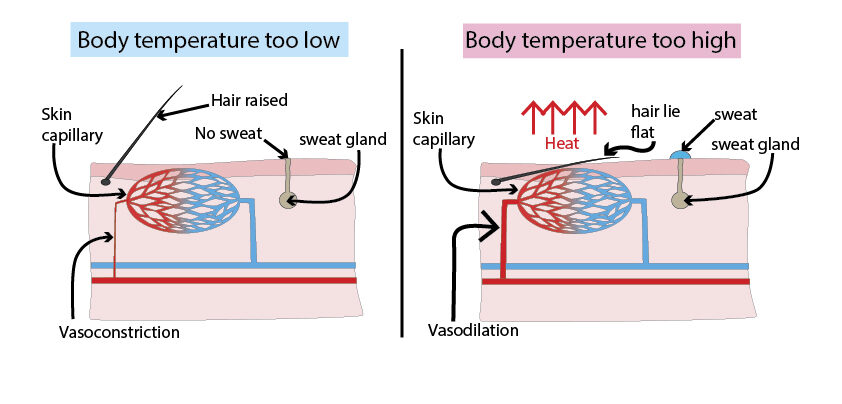
| Vasoconstriction occurs, where blood vessels supplying the skin capillaries constrict. This reduces blood flow near the surface of the skin, so less energy is transferred from the skin to the surroundings. | Vasodilation occurs, where blood vessels supplying the skin capillaries widen. This increases blood flow near the surface of the skin, so more energy is transferred from the skin to the surroundings, lowering body temperature. |
| Sweating stops, so there is no evaporation from the skin. As a result, less energy is transferred from the body to the surroundings. | Sweating occurs, and sweat evaporates from the skin. Evaporation requires energy, which is taken from the skin, causing body temperature to decrease. |
| Hairs are raised, this traps an insulating layer of air next to the skin surface | Hairs lie flat on the skin surface, no insulating layer of air is trapped next to the skin. |
| Shivering involves the rapid contraction of skeletal muscles. This increases respiration, which releases energy as heat, causing body temperature to rise. |
Changes in the skin for temperature change.
Below is an image showing the outer and lower layer of skin when the temperature is too low, or too high.
Notice how in vasoconstriction and vasodilation it is the blood vessel which supplies the skin’s capillaries that will dilate or constrict.
Practice Questions
1.State the typical core body temperature value for a human.
2. Name two ways the body loses heat when body temperature is too high.
3.A person is running on a hot day. Explain how sweating helps reduce body temperature.
Factors affecting the rate of photosynthesis
Measuring & calculating rates of photosynthesis
Inverse square law and photosynthesis
Economics of enhancing the conditions in greenhouses
Investigating the effect of light intensity on the rate of photosynthesis
Data analysis and nervous system
The effect of a factor on human reaction time
Controlling blood glucose concentration
Regulating water and nitrogen levels in the body.
Hormones and human reproduction
Using hormones to treat infertility
Control and coordination in plants using hormones
Investigating the effect of light or gravity on the growth of newly germinated seedlings