AQA GCSE Investigating the effect of light intensity on the rate of photosynthesis (Biology)
Investigating the effect of light intensity on the rate of photosynthesis
The aim is to investigate the effect of light intensity on the rate of photosynthesis using an aquatic organism such as pondweed.
Measure the rate of photosynthesis using an aquatic plant (e.g. pondweed)
Explain results using limiting factors.
Apparatus
Pondweed (e.g. Elodea)
Lamp (NOT sunlight)
Ruler or metre ruler
Beaker of water
Sodium hydrogencarbonate solution (CO₂ source)
Stopwatch
Thermometer (optional but useful)
Funnel
Water tank
Key setup points:
Cut pondweed under water (prevents air bubbles blocking xylem)
Pondweed positioned with cut end up
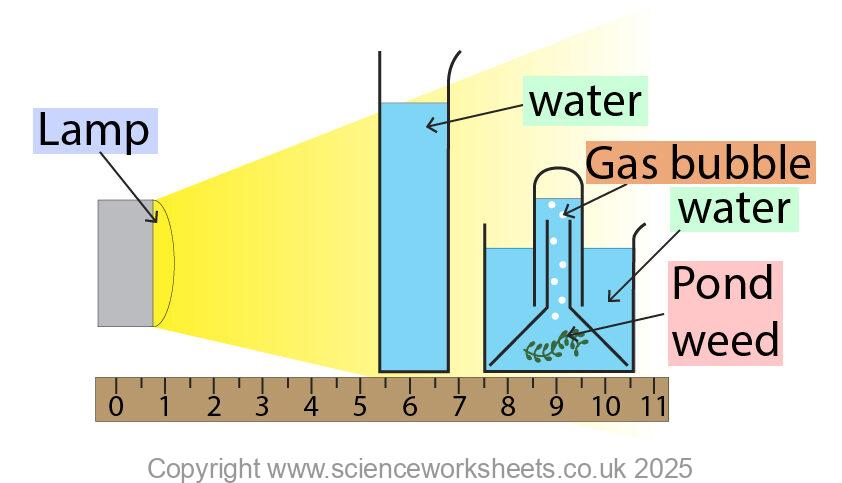
Lamp placed at measured distances from the pond weed.
Method
Place the pondweed in a beaker containing sodium hydrogencarbonate solution.
Position the lamp 10 cm from the pondweed.
Leave the setup for 2 minutes to allow the plant to acclimatise.
Count the number of oxygen bubbles produced in 1 minute.
Repeat the count and calculate a mean.
Move the lamp further away and repeat the measurements.
Variables
Independent variable
Light intensity
(usually changed by altering distance of lamp to the pond weed)
Dependent variable
Rate of photosynthesis which is measured by:
Number of oxygen bubbles per minute
OR
volume of oxygen produced (higher level)
Control variables (must be stated clearly)
Temperature
Carbon dioxide concentration
Same pondweed / same length of pondweed
Same colour/type of light
Results
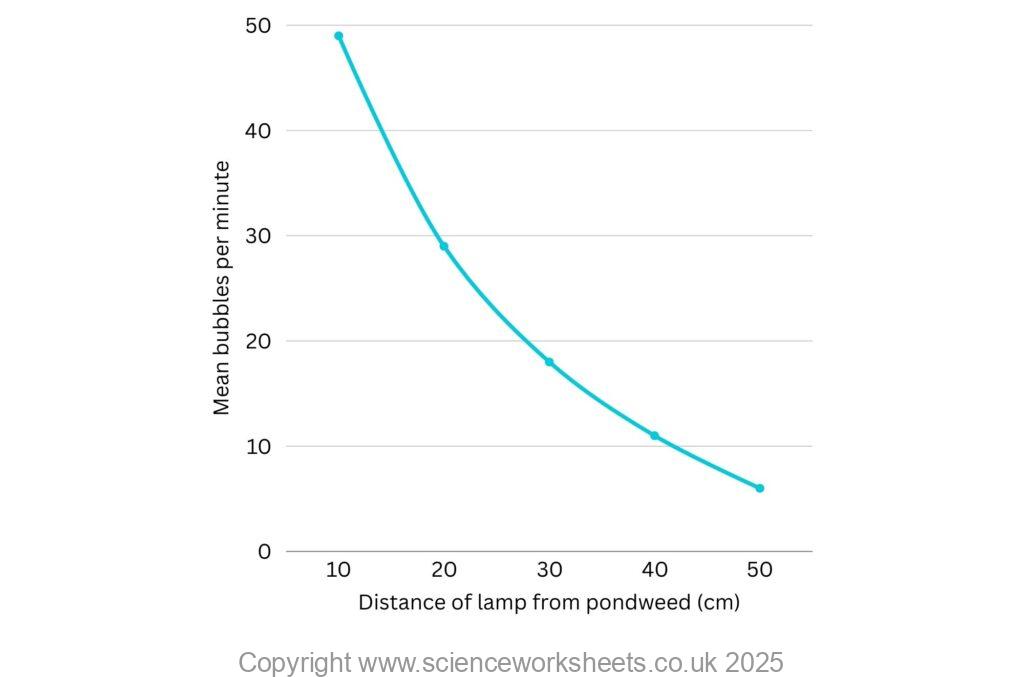
Below are possible sample results
| Distance of lamp from pondweed (cm) | Number of bubbles in 1 minute (Trial 1) | Number of bubbles in 1 minute (Trial 2) | Mean bubbles per minute |
|---|---|---|---|
| 10 | 50 | 48 | 49 |
| 20 | 31 | 27 | 29 |
| 30 | 17 | 19 | 18 |
| 40 | 10 | 12 | 11 |
| 50 | 5 | 7 | 6 |
Explaining the results
As the distance between the lamp and pond weed decreases, light intensity will increase.
As light intensity increases, the rate of photosynthesis increases and there is more light energy available for photosynthesis.
At low light intensity, light is the limiting factor.
At higher light intensities, the rate levels off because another factor becomes limiting (e.g. carbon dioxide or temperature).
Evaluation
Limitations
Bubble size varies
Temperature may increase due to the lamp emitting thermal energy
Improvements
Use a heat filter or water bath (see our diagram above), this has a water tank between the lamp and pond weed.
Measure volume of oxygen instead of counting bubbles
Use an LED lamp as it emits very little thermal energy
Practice Questions
1.Why does the rate of photosynthesis increase as light intensity increases?
2.Why does the rate eventually level off?
3.Why is sodium hydrogencarbonate used?
4.Which variable must be kept constant to ensure a fair test?
Factors affecting the rate of photosynthesis
Measuring & calculating rates of photosynthesis
Inverse square law and photosynthesis
Economics of enhancing the conditions in greenhouses
Investigating the effect of light intensity on the rate of photosynthesis
Data analysis and nervous system
The effect of a factor on human reaction time
Controlling blood glucose concentration
Regulating water and nitrogen levels in the body.
Hormones and human reproduction
Using hormones to treat infertility
Control and coordination in plants using hormones
Investigating the effect of light or gravity on the growth of newly germinated seedlings