AQA GCSE Making Monoclonal Antibodies (Biology)
Making Monoclonal Antibodies
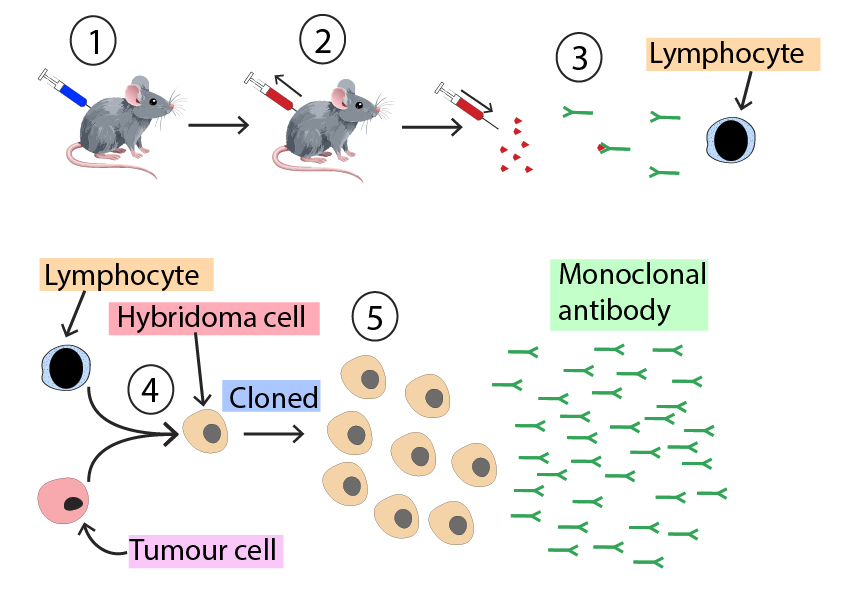
Monoclonal antibodies are produced from a single clone of cells.
1.A source of antigens are injected into the mouse. The mouse lymphocytes(white blood cells) will produce antibodies in response to the injected antigens.
2. A sample of blood is withdrawn from the mouse
3.The blood sample will contain mouse lymphocytes, antibodies (green) and antigens (red).
4. These lymphocytes which produced the antibodies to the injected antigens are fused with a tumour cell to form a hybridoma cell
5. The hybridoma cell will be cloned by dividing to produce many identical cells. Each of these identical cells will produce the same antibody (monoclonal antibody).
A large amount of the antibody can be collected and purified.
The Specific nature of antibodies.
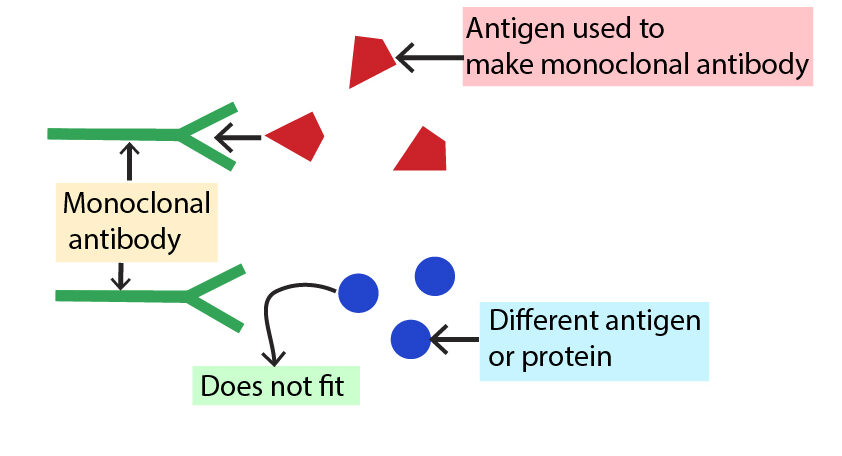
Each antibody is specific to a particular antigen.
The shape of the antibody is complementary to that of the antigen.
The antibodies are specific to one binding site on one protein antigen and so are able to target a specific chemical or specific cells in the body.
In the diagram below the monoclonal antibody (green) can bind to the red antigen, but not to the blue antigen. This is because the blue antigen has the wrong shape.
Practice Questions
1.What are monoclonal antibodies?
2. Outline the steps on how to produce monoclonal antibodies
3. Why are monoclonal antibodies so useful?
Factors affecting the rate of photosynthesis
Measuring & calculating rates of photosynthesis
Inverse square law and photosynthesis
Economics of enhancing the conditions in greenhouses
Investigating the effect of light intensity on the rate of photosynthesis
Data analysis and nervous system
The effect of a factor on human reaction time
Controlling blood glucose concentration
Regulating water and nitrogen levels in the body.
Hormones and human reproduction
Using hormones to treat infertility
Control and coordination in plants using hormones
Investigating the effect of light or gravity on the growth of newly germinated seedlings