AQA GCSE Vaccination (Biology)
Vaccination
Vaccination is used to :
1.Prevent some communicable diseases in individuals
2. Reducing the spread of pathogens by vaccinating a large proportion of the population.
How vaccines work. (Overall summary)
Vaccination involves introducing small quantities of dead or inactive forms of a pathogen into the body to stimulate the white blood cells to produce antibodies.
If the same pathogen re-enters the body the white blood cells respond quickly to produce the correct antibodies, preventing infection.
How vaccines work in detail
A vaccine contains dead or weakened pathogens, or the antigens from a pathogen.
These antigens from the vaccine cannot cause disease, but they do have the same antigens as the real pathogen.
When the vaccine is injected, the immune system detects the antigens and white blood cells produce antibodies against them.
Some of these white blood cells become memory cells, which stay in the body for a long time.
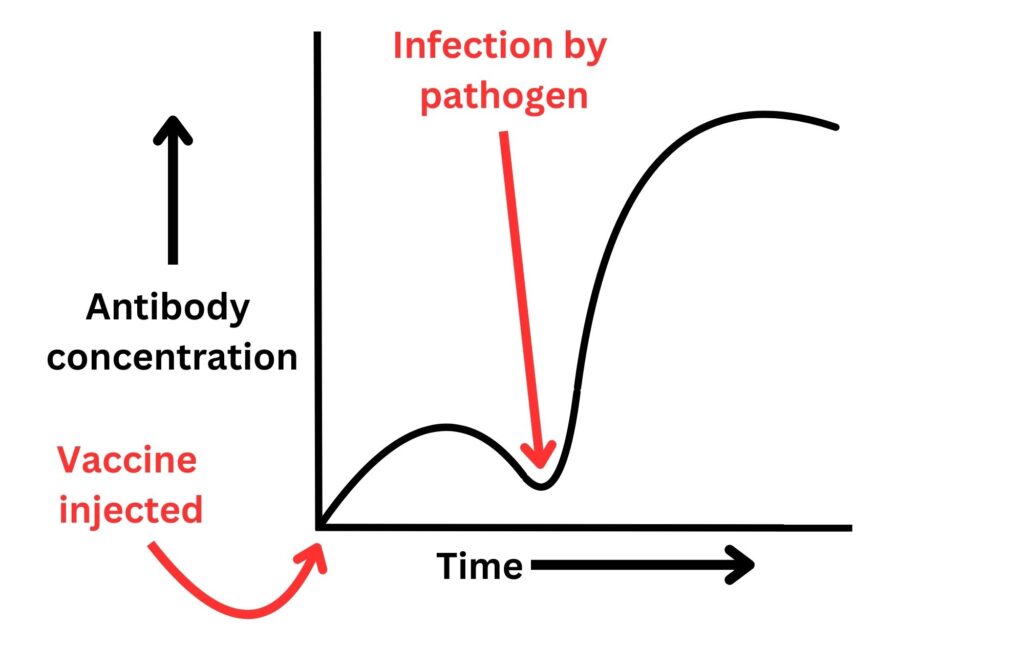
If the real pathogen enters the body later, the memory cells recognise its antigens and the immune system produces large amounts of antibodies very quickly.
The pathogen is destroyed before it can multiply enough to cause illness.
In the graph below, the injected vaccine causes a small number of antibodies to be produced. However, later when the person is infected by the pathogen, the antibodies are produced faster and in a greater concentration. As a result, the pathogen will be killed.
Using vaccines to prevent the spread of a pathogen.
Immunising many people reduces the spread of disease:
Vaccinated people are much less likely to become infected.
Their immune system destroys the pathogen quickly.
Because fewer people get infected, there are fewer people who can pass the pathogen on to others.
This means the overall transmission rate falls, so the disease spreads much more slowly or may even stop spreading completely.
If enough people are vaccinated (a high vaccination rate), even people who are not vaccinated are protected because the pathogen struggles to find new hosts. This is called HERD IMMUNITY.
Evaluating the global use of vaccination in the prevention of disease.
| Benefits of vaccination globally | Limitations / challenges of global vaccination |
|---|---|
| Reduces deaths and illness worldwide (e.g., measles, polio). | Cost – poorer countries may not afford vaccines. |
| Protects vulnerable populations (babies, elderly, immunocompromised). | Distribution issues – need fridges (“cold chain”), transport, trained staff. |
| Can eliminate diseases (e.g., smallpox eradicated). | Conflict zones / remote areas make vaccination difficult. |
| Prevents epidemics and pandemics by reducing spread. | Vaccine hesitancy – mistrust, misinformation, cultural beliefs. |
| Cheaper for countries long-term (prevention costs less than treatment). | Mutation of pathogens – vaccines may need updating (e.g., flu). |
| Improves quality of life and keeps people in work/school. | Inequality – richer countries may get vaccines first. |
Practice Questions
1.State two reasons why we vaccinate individuals
2. Summarise how vaccines work to protect us against communicable disease
3. Define the term herd immunity
Factors affecting the rate of photosynthesis
Measuring & calculating rates of photosynthesis
Inverse square law and photosynthesis
Economics of enhancing the conditions in greenhouses
Investigating the effect of light intensity on the rate of photosynthesis
Data analysis and nervous system
The effect of a factor on human reaction time
Controlling blood glucose concentration
Regulating water and nitrogen levels in the body.
Hormones and human reproduction
Using hormones to treat infertility
Control and coordination in plants using hormones
Investigating the effect of light or gravity on the growth of newly germinated seedlings