AQA GCSE Transpiration (Biology)
Transpiration
Transpiration is defined as the loss of water vapour from the leaves of the plant, through the open stomata
When sunlight shines onto the leaves, the guard cells will open the stomata to allow gas exchange for photosynthesis.
However, when the stomata are open, water vapour can diffuse out of the stomata, causing transpiration.
Rate of transpiration
Rate of transpiration is a measure of the amount of water loss per unit time.
The units can vary, but one example of a unit for rate of transpiration could be cm3/min
Rate of transpiration is affected by changes to:
1.Temperature
2.Humidity
3.Air movement
4. Light intensity
| Factor | Rate of transpiration |
|---|---|
| Light intensity | Increasing light intensity will cause more guard cells to open the stomata to allow gas exchange for photosynthesis, this will increase the rate of transpiration |
| Temperature | As temperature increases the molecules gain more kinetic energy, so they move faster, which increases the rate of diffusion and so the rate of transpiration will also increase. In addition, higher temperatures can increase the rate of photosynthesis. To take in more carbon dioxide for photosynthesis, the plant opens more stomata. More open stomata means more water vapour can escape, so the rate of transpiration increases further. |
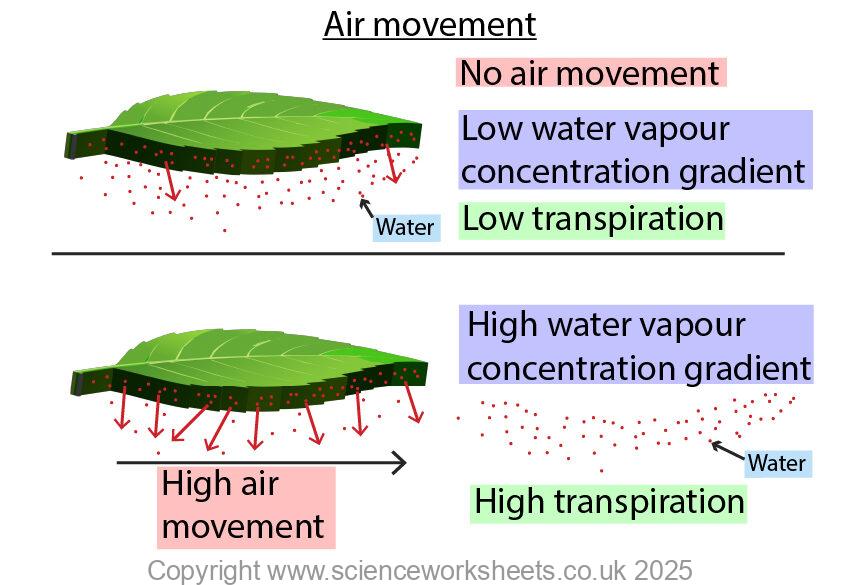
| Air movement | More air flow means increased wind speed. The air movement will move water vapour away from the leaf, increasing the water vapour concentration gradient between inside of the leaf and the outside, therefore increasing the rate of transpiration. |
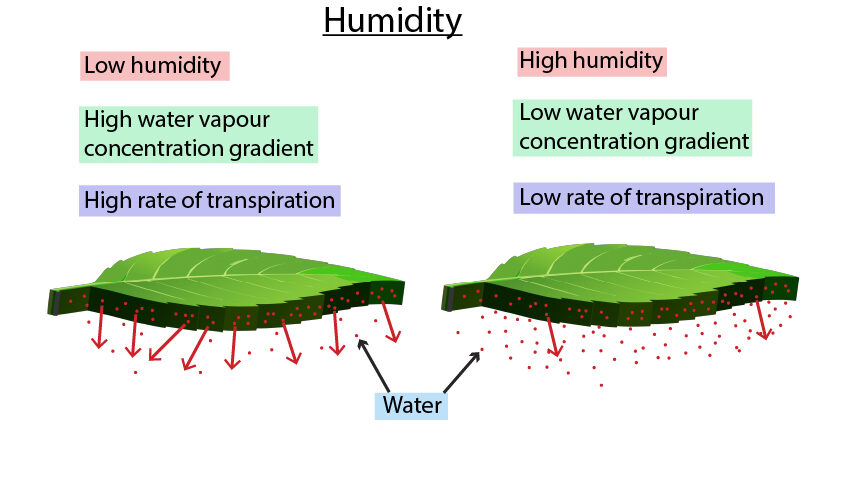
| Humidity | Humidity is a measure of the amount of water vapour in the atmospere. High humidity means a lot of water vapour in the atmosphere. As humidity increases, there is a smaller water vapour concentration gradient between the inside of the leaf and the outside, so rate of transpiration will decrease. |
The Process of Transpiration
Both the upper and lower surfaces of a leaf have tiny pores called stomata (singular: stoma). When the stomata are open, gases exchange can occur and water vapour can diffuse out.
There are more stomata on the lower surface of the leaf, than the upper surface.
Guard cells open and close the stomata. When the guard cells are full of water (turgid) the stomata will be open. This is because the inner middle region of the guard cell is thicker, so it cannot bend. As the guard cells fill with water (become turgid) the top and bottom of both guard cells push each other to open the stomata.
When the guard cells have less water (flaccid), the stomata will be closed.

Flow of water across leaf structure
Looking at the image below:
1.Water vapour inside the air spaces of the leaf will diffuse out of the open stomata.
2. Water in the cell walls of the mesophyll cells will evaporate and replace the water that has been lost from the air spaces of the leaf.
3. Water that has been lost from one mesophyll cell due to evaporation will be replaced from another mesophyll cell.
4. Eventually water from the mesophyll cells is replaced by water from the xylem.
In the diagram below, the black arrow indicates the direction of the water flow.

Water will now move from the roots, up the xylem to the leaf to replace the water that the leaf has lost.
The transpiration stream is the continuous movement of water from the roots, through the xylem, up the stem, and to the leaves, where water evaporates from the leaf surface and diffuses out through the stomata.
Below is an image showing the flow of water from the soil, into root hair cell, across root cortex, up the xylem, into leaf and out of the leaf, through the stomata.
Just a quick reminder, water enters the root hair cell, from the soil by osmosis. This was mentioned on plant organs page, see note directly below!
Remember to review the two previous pages about plant organs, these will contain information about the structure and function of the xylem!

Practice Questions
1.Define the term transpiration
2. State 4 factors that affect the rate of transpiration
3. Define the term transpiration stream
Factors affecting the rate of photosynthesis
Measuring & calculating rates of photosynthesis
Inverse square law and photosynthesis
Economics of enhancing the conditions in greenhouses
Investigating the effect of light intensity on the rate of photosynthesis
Data analysis and nervous system
The effect of a factor on human reaction time
Controlling blood glucose concentration
Regulating water and nitrogen levels in the body.
Hormones and human reproduction
Using hormones to treat infertility
Control and coordination in plants using hormones
Investigating the effect of light or gravity on the growth of newly germinated seedlings