AQA GCSE Plant Organ System Part 2 (Biology)
Plant organ system
An organ system contains organs working together to carry out a function for an organism.
The organ system of a plant, is the whole body of the plant.
The roots, stem and leaves are all organs.
All three of these organs will work together to form a plant organ system for transport of substances around the plant.
Structure of the Stem.
Below is an image of the cross section of a stem.
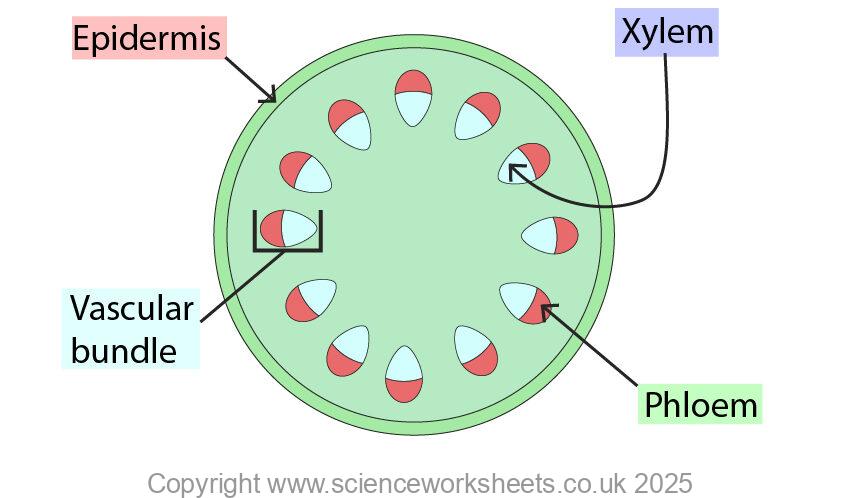
The stem contains vascular bundles. These vascular bundles will contain both xylem tissue and phloem tissue.
Xylem tissue
Xylem tissue is made up of xylem vessels.
Xylem vessels transports water and mineral ions from the roots to the stems and leaves.
Xylem is a hollow tube which is strengthened by lignin. Xylem is adapted for the transport of water in the transpiration stream.
The transpiration stream is the movement of water from the roots to the leaves of the plant.
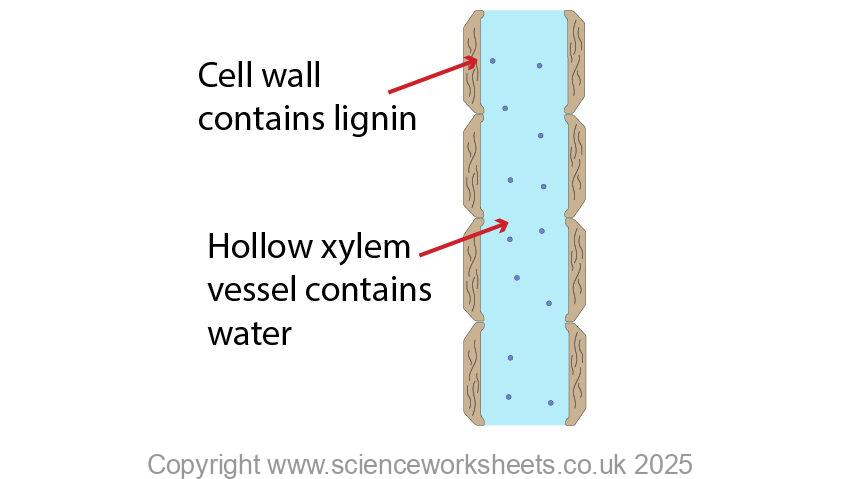
How Xylem is adapted
| Structural part of Xylem | Adaptation |
|---|---|
| Hollow tubes (no end walls / no cytoplasm) | Allows water to flow freely from root to leaf. |
| Lignin in cell walls | Strengthens the tubes and prevents them collapsing under pressure. Helps waterproof the vessels. |
| Thick walls | Give support to the plant, helping keep it upright. |
| One-way flow | Water and minerals move upwards only — from roots to leaves. |
Phloem Tissue
Phloem tissue is made of sieve tube elements and companion cells.
Phloem will transport dissolved sugars(sucrose) and amino acids from the leaves to the rest of the plant for immediate use in fruits or storage in the roots.
Translocation is the name given to the process where food molecules (sugars or amino acids move through the phloem tissue.
Phloem is composed of tubes of elongated cells called sieve tube elements.
Cell sap can move from one phloem cell to the next through pores in the end walls. These pores are in sieve plates, see the diagram below.

How Phloem is adapted
| Structural part of Phloem | Adaptation |
|---|---|
| Sieve tube elements | Long cells joined end to end to form tubes for transport. Have sieve plates (holes at ends) that allow sugars to flow. |
| Companion cells | Each sieve tube has a companion cell beside it. Contain lots of mitochondria to provide energy for active transport of sugars. |
| Cells are alive | Unlike xylem, phloem vessels are living cells, necessary for active transport. |
| Bidirectional flow | Sugars can move up or down the plant to where they are needed (e.g. growing regions or storage organs). |
Leaves
A leaf is an organ, because it contain different tissues as shown below.
The midrib is the main vein, it contains a vascular bundle, this in turn contains xylem and phloem.
There are other vascular bundles which contain xylem and phloem.

Xylem brings water and minerals ions to the leaf
Phloem transports sucrose and amino acids away from the leaf.
The stomata on the lower surface allow gas exchange for photosynthesis.
The guard cells open and close the stomata to control gas exchange and water loss.
When the sun shines, guard cells open stomata for gas exchange. However, if the plant loses too much water by transpiration, then the stomata are shut to reduce water loss.

Practice Questions
1.State what a vascular bundle contains
2. Describe 3 adaptations of xylem
3. Describe 3 adaptations of phloem
Factors affecting the rate of photosynthesis
Measuring & calculating rates of photosynthesis
Inverse square law and photosynthesis
Economics of enhancing the conditions in greenhouses
Investigating the effect of light intensity on the rate of photosynthesis
Data analysis and nervous system
The effect of a factor on human reaction time
Controlling blood glucose concentration
Regulating water and nitrogen levels in the body.
Hormones and human reproduction
Using hormones to treat infertility
Control and coordination in plants using hormones
Investigating the effect of light or gravity on the growth of newly germinated seedlings