AQA GCSE Plant tissue types (Biology)
Plant tissue types
A tissue is a group of cells with a similar structure and function.
Plants contain several types of tissue:
1. Epidermal tissues
2. Palisade mesophyll
3. Spongy mesophyll
4. Xylem
5. Phloem
6. Meristem tissue
You will need to be able to relate the structure of a tissue to its function.
Structure of a leaf
The leaf is an example of a plant organ.
An organ is a group of tissues working together to carry out a specific function.
The midrib is the central vein of the leaf, this will contain a vascular bundle, which in turn contains xylem and phloem.

The image below shows a more zoomed in version of the one above.
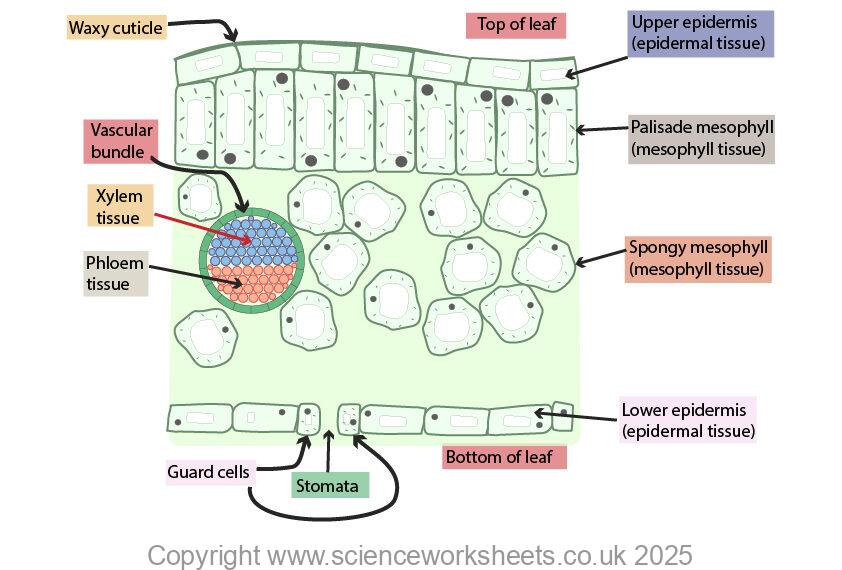
| Leaf Structure | Structure | Function |
|---|---|---|
| Waxy cuticle | Transparent waxy layer | Reduces water loss from the leaf |
| Upper epidermis | Transparent, one cell thick; Does not contain chloroplasts. | Transparent to allow light to reach chloroplasts in the mesophyll tissue. |
| Palisade mesophyll | Palisade mesophyll cells contain many tightly packed chloroplasts. | This is the main photosynthetic layer. |
| Spongy mesophyll | Loosely packed cells with air spaces between cells Cells do contain chloroplasts | There are many air spaces between the cells so that gases can circulate. Individual cells have a large surface area to volume ratio for high rate of diffusion of oxygen and carbon dioxide. Will carry out photosynthesis |
| Vascular bundle | Surrounds xylem and phloem | Contains Xylem and Phloem |
| Xylem | Hollow tubes, strong walls which contain lignin | Transports water and mineral ions from the roots, up the stem to the leaves |
| Phloem | Phloem tissue contains companion cells and sieve tubes Sieve tubes contain sieve plates | Transports sucrose and amino acids from the leaves to other parts of the plant such as roots or fruits. |
| Guard cells | Surround the stomata | Open and close the stomata. Stomata is opened to allow gas exchange for photosynthesis. If the plant loses too much water then the stomata is closed to help prevent further water loss from the plant. |
| Stomata | Pore | Pores to allow for gas exchange. |
Meristem tissue
Meristem tissue is found at the tips of roots and shoots. It makes new cells for growth.
Meristem tissue contains undifferentiated cells which can differentiate to form any cell type.
This allows plants to grow taller, grow roots, and form new leaves, xylem, phloem, etc.
The leaf as a photosynthetic organ
The leaf is a photosynthetic organ adapted to capture light and exchange gases efficiently.
This is how the leaf is adapted for its role in photosynthesis.
| Leaf feature | How it is adapted |
|---|---|
| Leaf surface | Large surface area to absorb more sunlight |
| Thin | Short diffusion distance for gases |
| Chloroplasts contain chlorophyll | Chlorophyll will absorb light energy for photosynthesis |
| Veins which contain xylem and phloem | Xylem transports water and mineral ions from roots to the leaves. Phloem transports sucrose and amino acids from the leaf to other parts of the plant such as fruits or roots. |
| Air spaces in leaf | Spongy mesophyll section has air spaces to allow gases to circulate by diffusion |
| Guard cells | Guard cells open and close the stomata |
Practice Questions
1.State the definition of a tissue
2. List the names of three different plant tissues.
3. Describe 3 ways the leaf is adapted for photosynthesis.
Factors affecting the rate of photosynthesis
Measuring & calculating rates of photosynthesis
Inverse square law and photosynthesis
Economics of enhancing the conditions in greenhouses
Investigating the effect of light intensity on the rate of photosynthesis
Data analysis and nervous system
The effect of a factor on human reaction time
Controlling blood glucose concentration
Regulating water and nitrogen levels in the body.
Hormones and human reproduction
Using hormones to treat infertility
Control and coordination in plants using hormones
Investigating the effect of light or gravity on the growth of newly germinated seedlings