AQA GCSE Cancer (Biology)
Cancer
Cancer occurs as the result of changes in cells that lead to uncontrolled growth of a tumour and cell division.
Body cells divide by a process called mitosis as shown below.
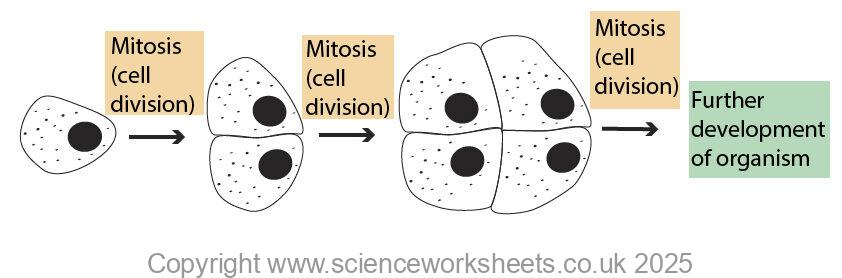
Cells normally divide at the right speed, by mitosis, and this process is carefully controlled.
But if the DNA in a cell becomes damaged or changes (a mutation), the cell can start dividing too fast and out of control — this can lead to cancer.
Sometimes, the control mechanism for mitosis will go wrong, leading to uncontrolled cell division. Initially, a tumour (growth of cells) will form.
There are two types of tumours:
1. Benign tumours
2.Malignant tumours
Benign tumours
Benign tumours are growths of abnormal cells which are contained in one area, usually within a membrane.
They will not invade or spread to other parts of the body.
Malignant tumours
Malignant tumour cells are cancerous (cancers).
Malignant tumours will invade neighbouring tissues and spread to different parts of the body using the blood or lymph where they form secondary tumours.
Malignant tumours will replace healthy organ tissue with cancerous tissue. This decreases organ function and if untreated will lead to death.
Risk Factors for Cancer.
A risk factor is a factor that increases your chance of developing a particular disease, such as cancer.
Risk factors for cancer include both lifestyle and genetic.
Risk Factors for Cancer.
| Risk factor | Type of cancer |
|---|---|
| High fat or low fibre diet | Bowel cancer |
| Alcohol | Liver cancer |
| UV radiation (sun or sunbeds) | Skin cancer |
| Asbestos exposure | Lung cancer |
| Genetic | BRCA1 or BRCA2 gene increases risk of breast & ovarian cancer |
| Age | Older adults are more at risk of developing cancers |
| HPV virus | Increased risk of cervical cancer |
| Hepatitis B or C virus | Increased risk of liver cancer |
Practice Questions
1.State what is meant by a tumour.
2. What are the two types of tumours?
3.Why are malignant tumours more dangerous than benign tumours?
Factors affecting the rate of photosynthesis
Measuring & calculating rates of photosynthesis
Inverse square law and photosynthesis
Economics of enhancing the conditions in greenhouses
Investigating the effect of light intensity on the rate of photosynthesis
Data analysis and nervous system
The effect of a factor on human reaction time
Controlling blood glucose concentration
Regulating water and nitrogen levels in the body.
Hormones and human reproduction
Using hormones to treat infertility
Control and coordination in plants using hormones
Investigating the effect of light or gravity on the growth of newly germinated seedlings