AQA GCSE Blood Vessels (Biology)
Blood vessels
In the human body there are three types of blood vessel.
1.Arteries
2.Veins
3.Capillaries
Arteries
Arteries transport blood away from the heart to organs.
A lot of students think that arteries only ever carry oxygenated blood. This is not true. The pulmonary artery transports deoxygenated blood from the heart to the lungs.

Arteries have a thick wall to withstand the high blood pressure.
Arteries have a smooth endothelium so the blood can flow over with reduced friction.
Arteries do not have valves, they do not need them due to the high pressure of the blood.
Arteries contain elastic tissue, when the heart contracts and pumps the blood, it causes the elastic tissue to stretch and then recoil.
Elastic tissue helps to:
1.Smooth out the pulses of blood to a continuous flow.
2.Maintain blood pressure.
When you measure your pulse, by placing your fingers on your wrist, you actually measure the artery wall pulsating!
Arteries have a narrow lumen to maintain blood pressure.
Veins
Veins carry blood from the organs back to the heart.
A lot of students think that veins only ever carry deoxygenated blood. This is not true. The pulmonary vein transports oxygenated blood from the lungs to the heart.
Veins have a wide lumen.
Veins have thin walls, due to low blood pressure

Veins have valves to prevent the back flow of blood, due to the low pressure.
In the image below, a leg vein is between the calf muscles. When the person moves their leg, the calf muscle contracts, which squeezes the wall of the vein, helping to return the blood back to the heart. This mechanism is known as the skeletal muscle pump.
When the muscle contracts the valves in the vein open. When the muscle relaxes, the valve shuts preventing the backflow of blood.

Capillaries
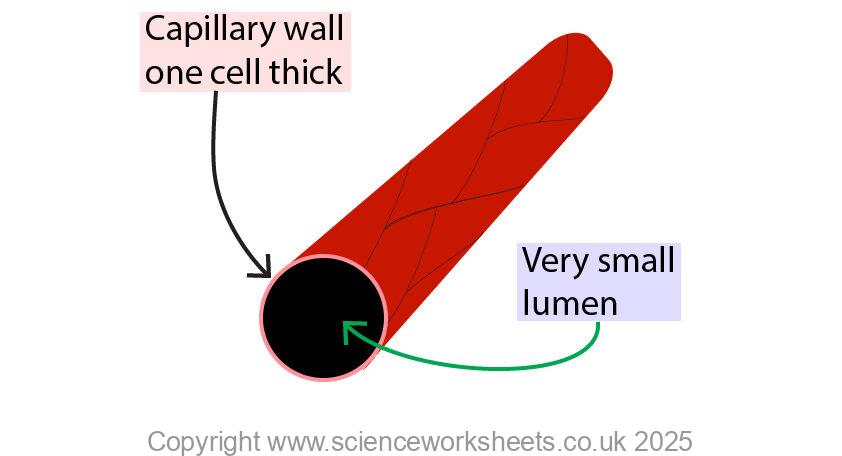
Capillaries are used for the exchange of substances between the blood and the tissues.
Capillaries are narrow and their wall is one cell thick, so there is a short diffusion distance to increase the rate of diffusion.
Substances such as glucose, oxygen and carbon dioxide are exchanged between the blood and the tissues.
| Artery | Vein | Capillary | |
|---|---|---|---|
| Wall | Thick | Thin | Thin, one cell thick |
| Elastic tissue | Thick layer | Thin layer | None |
| Muscle tissue | Thick layer | Thin layer | None |
| Valves | None present | Present | None |
| Function | Transports blood from heart to organs | Transports blood from organs to heart | Allows exchange of substances between blood and tissues |
Practice Questions
1.State the names of the three blood vessels present in animals.
2. Describe how the structure of an artery is different to that of a vein
3. Why do veins need valves?
Factors affecting the rate of photosynthesis
Measuring & calculating rates of photosynthesis
Inverse square law and photosynthesis
Economics of enhancing the conditions in greenhouses
Investigating the effect of light intensity on the rate of photosynthesis
Data analysis and nervous system
The effect of a factor on human reaction time
Controlling blood glucose concentration
Regulating water and nitrogen levels in the body.
Hormones and human reproduction
Using hormones to treat infertility
Control and coordination in plants using hormones
Investigating the effect of light or gravity on the growth of newly germinated seedlings