AQA GCSE Lungs (Biology)
Heart
The heart is made up of cardiac muscle. Around the outside of the heart are the coronary arteries, these supply the heart muscle with oxygenated blood.

Role of the Heart
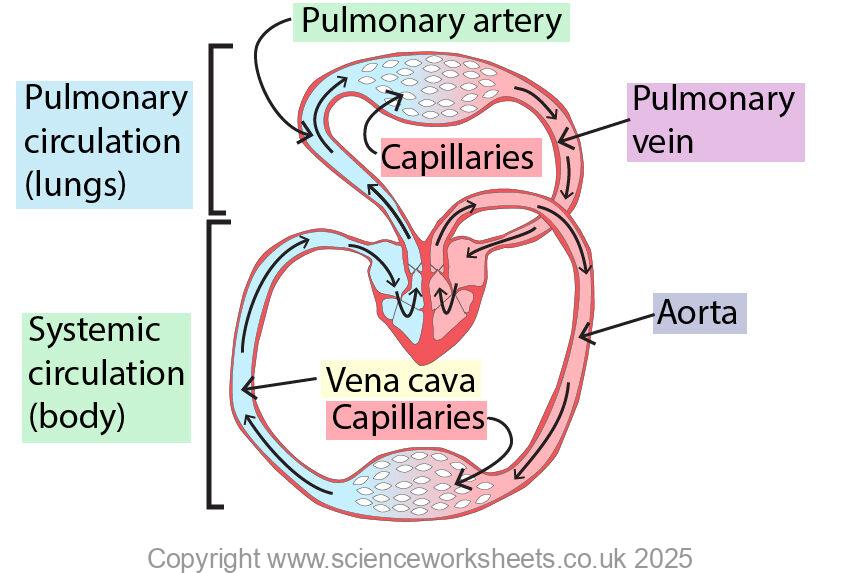
The heart is an organ that pumps blood around the body in a double circulatory system.
The right ventricle pumps blood to the lungs where gas exchange takes place, this is known as pulmonary circulation.
The left ventricle pumps blood around the rest of the body, this is known as systemic circulation.
We use a double circulatory system because it is more efficient. Once the blood has flowed through the lungs it is at a lower pressure. The pressure would not be enough to allow the blood to flow around the body.
So, the blood is returned to the heart, where the pressure is increased, so it has sufficient pressure to travel around the whole body, before the blood is returned to the heart, so the cycle can repeat.
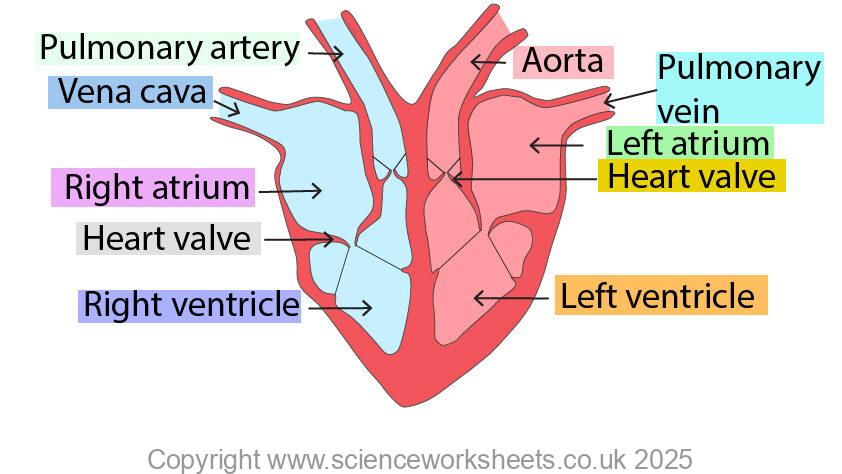
Structure of the Heart.
The heart contains 4 chambers. 2 Atria and 2 ventricles.
The right side of the heart receives deoxygenated blood from the body and then pumps this deoxygenated blood to the lungs for oxygenation.
The oxygenated blood then flows back to the heart, before being pumped around the body. The blood then returns to the right side of the heart and the cycle repeats.
How the heart pumps the blood.
Blood enters the atria of the heart from the veins.
Both atria contract together forcing blood down into the ventricles below.
The ventricles then contract, forcing blood out of the heart through the arteries.
The heart muscle will then relax and the cycle repeats.
Flow of blood through the heart.
Blood will flow through the following structures during double circulation
Vena cava>Right atrium>right ventricle>pulmonary artery>lungs>pulmonary vein>left atrium>left ventricle>aorta>body>vena cava
The process will keep repeating in a cyclic loop.
| Right side of heart | Left side of heart | |
|---|---|---|
| Deoxygenated or oxygenated blood | Deoxygenated blood | Oxygenated blood |
| Receives blood from | Right atrium receives blood from the body via the vena cava | Left atrium receives blood from lungs via the pulmonary vein |
| Pumps blood to | Right ventricle pumps blood to the lungs for oxygenation | Left ventricle pumps blood to the body to supply oxygen to the tissues |
| Thickness of ventricle wall | Thinner | Thicker |
Heart Valves
Heart valves prevent the backflow of blood.
The heart has two sets of valves
One set is between the atria and the venticles, these prevent the backflow of blood from the ventricles to the atria, when the ventricles contract
The other set is between the arteries and the ventricles, these prevent the backflow of blood when the heart relaxes, just after the ventricles have contracted.
When a doctor uses a stethoscope to listen to your heart, the lub dub sound they hear is the shutting of the heart valves.
Thickness of the ventricle walls.
The left ventricle wall is thicker than the right ventricle wall.
This is because:
Left ventricle pumps oxygenated blood around the whole body, which is a greater distance, so it needs a stronger force of contraction with more pressure
Right ventricle pumps deoxygenated blood to the lungs which is a shorter distance, so it does not need such a strong force of contraction.
Practice Questions
1. State the name for the type of muscle that the heart is made up of.
2. Fill in the table below
| Receives blood from | Transfers blood to | |
|---|---|---|
| Pulmonary artery | ||
| Pulmonary vein | ||
| Aorta | ||
| Vena cava |
3. State the function of heart valves
Factors affecting the rate of photosynthesis
Measuring & calculating rates of photosynthesis
Inverse square law and photosynthesis
Economics of enhancing the conditions in greenhouses
Investigating the effect of light intensity on the rate of photosynthesis
Data analysis and nervous system
The effect of a factor on human reaction time
Controlling blood glucose concentration
Regulating water and nitrogen levels in the body.
Hormones and human reproduction
Using hormones to treat infertility
Control and coordination in plants using hormones
Investigating the effect of light or gravity on the growth of newly germinated seedlings