AQA GCSE Lungs (Biology)
Lungs
Learn the labels on the diagram of the gas exchange system below.

| Structure | Function |
|---|---|
| Trachea | The trachea provides the airway that connects the mouth and nose to the lungs. Contains C shaped rings of cartilage which prevents the trachea collapsing, when breathing in. Trachea contains goblet cells that produce a sticky mucus to trap dust and pathogens from entering lungs. Cilliated cells line the trachea, they move mucus along with dust and pathogens up to the top of airways, where swallowing will take the mucus down the oesophagus into the stomach. |
| Bronchus or Bronchi | Bronchus is single, whilst bronchi is plural. The trachea splits into two bronchi, before entering the lungs. Both bronchi are lined with goblet cells and ciliated cells. |
| Bronchioles | "ioles" means subdivision in biology. So bronchioles are subdivisions of bronchi. These bronchioles will lead to the air sacs (alveoli). |
| Diaphragm | Sheet of muscle that separates the respiratory system from the digestive system. When breathing in the diaphragm contracts and flattens. When breathing out, the diaphragm relaxes and returns to its dome shape. |
| Ribs | Bone structures that are used to protect the gas exchange system. |
| Intercostal muscles | When the intercostal muscles contract it raises the rib cage during breathing in. During breathing out the intercostal muscles relax. (At a higher level than GCSE, you will learn about the difference between internal and external intercostal muscles, this is not needed for GCSE). |
| Alveoli | Alveoli are the air sacs where gas exchange occurs. These are surrounded by blood capillaries to aid diffusion of gases. |
Breathing in and breathing out.
| Structure | Breathing in | Breathing out |
|---|---|---|
| Intercostal muscles | Contract to raise the rib cage upwards and outwards | Relax to allow the rib cage to move downwards and inwards |
| Diaphragm | Contracts and flattens, increasing the volume of thorax (chest) | Relaxes and returns to its dome shape, decreasing the volume of the thorax (chest) |
| Chest (Thorax) | As volume of thorax increases, air pressure in lungs decreases, so air moves into the lungs. | As the volume of thorax decreases, air pressure in the lungs will increase, forcing air out of the lungs. |
Understanding why the air moves in and out.
Students often have problems understanding the changes in pressure and why this causes air to move into or out of the lungs, so lets do a side step and explain it!
Gas pressure is caused by gas particles colliding with the walls of a container and exerting a force on the walls. This force is at 90 degrees as shown below!
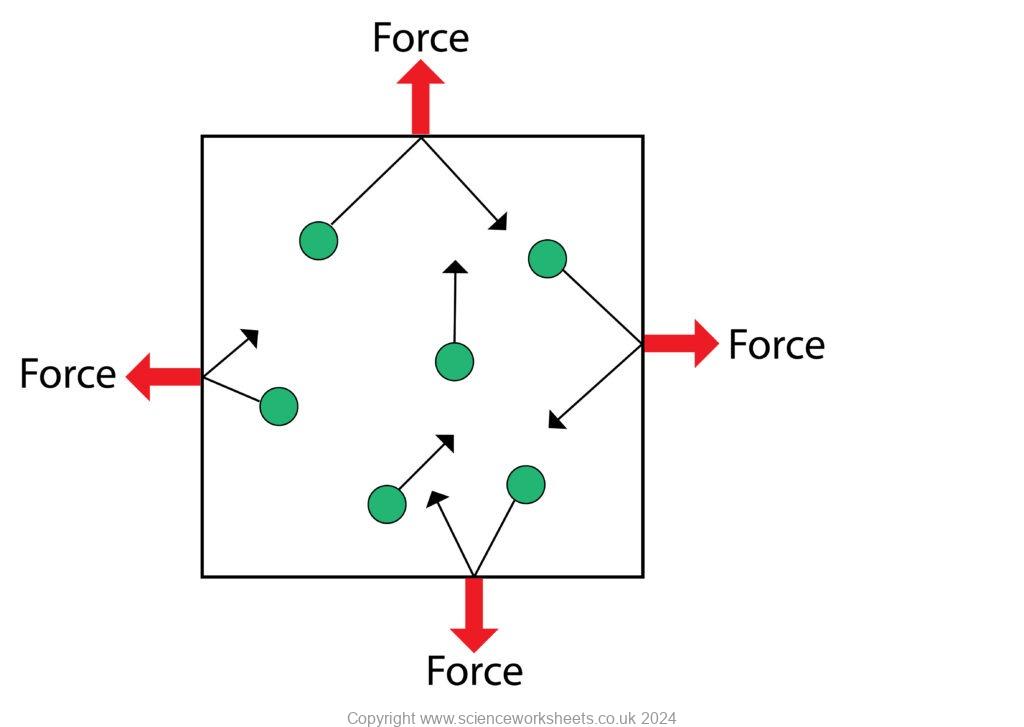
If the volume of a container is made smaller, it will contain the same number of gas particles, but they will collide with walls of the container more often, so the gas pressure increases.
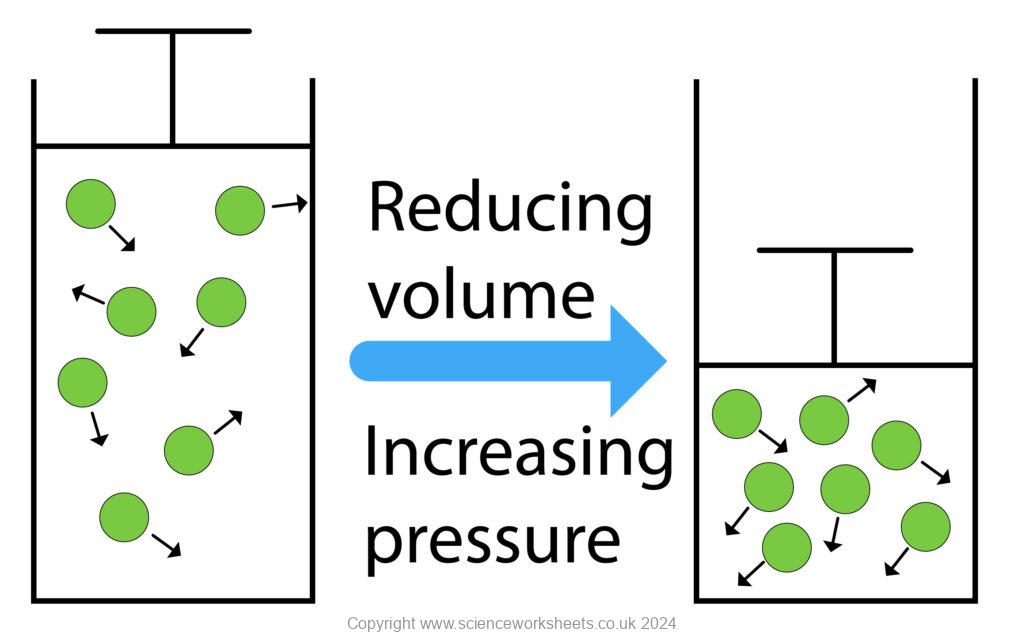
Lets relate this to the lungs, as the volume of the thorax decreases, gas pressure inside the lungs increases, so it will force the air out of the lungs!
Gas Exchange in Alveoli.
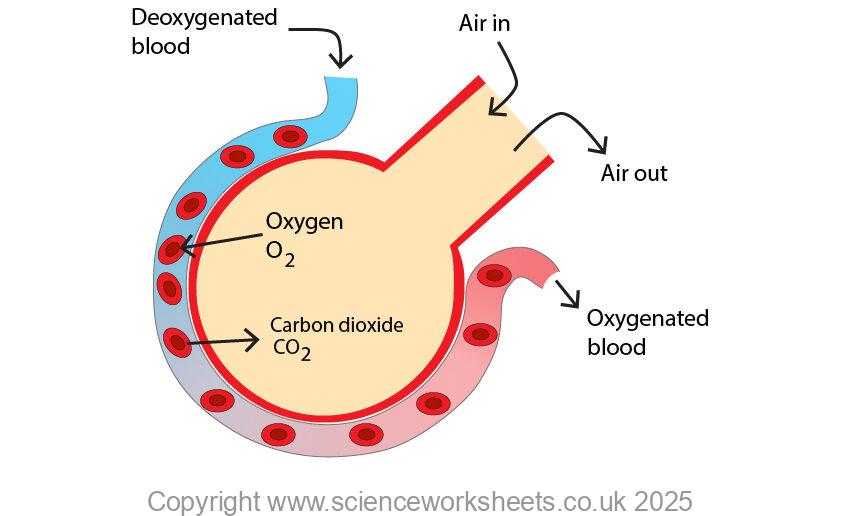
The alveoli allow gas exchange to occur, they are adapted for this process.
Once the air has been inhaled, oxygen will diffuse from the alveolus into the red blood cells.
Carbon dioxide from the red blood cells will diffuse into the alveolus.
During exhalation, carbon dioxide is removed from the body.
Adaptations for gas exchange.
The alveoli are adapted for gas exchange.
1.Alveoli provide a large surface area for gas exchange to occur
2. Alveoli have thin walls, short diffusion distance
3. Ventilation will replenish the air in the lungs, maintaining the concentration gradient.
4. Good blood supply brings deoxygenated blood and removes oxygenated blood. This maintains concentration gradient.
Practice Questions
1. Using the diagram below label each of the numbered parts.

2. State 3 ways that the alveoli are adapted for gas exchange
Factors affecting the rate of photosynthesis
Measuring & calculating rates of photosynthesis
Inverse square law and photosynthesis
Economics of enhancing the conditions in greenhouses
Investigating the effect of light intensity on the rate of photosynthesis
Data analysis and nervous system
The effect of a factor on human reaction time
Controlling blood glucose concentration
Regulating water and nitrogen levels in the body.
Hormones and human reproduction
Using hormones to treat infertility
Control and coordination in plants using hormones
Investigating the effect of light or gravity on the growth of newly germinated seedlings