AQA GCSE Qualitative Food Tests(Biology)
Qualitative Food Tests
Qualitative testing means to identify if a substance is present, or not present.
There are several food substances that you need to be able to test for:
1. Sugars (reducing sugars)
2.Starch
3. Protein
4. Lipids (fats)
Preparation of the food sample
The food sample is ground up with a small amount of water in a pestle and mortar.
In the image below a hazelnut is being ground up with water. This mixture is then tested for reducing sugars, starch, protein and lipids.

Test for Sugars (Reducing sugars)
A reducing sugar is a sugar that will give a positive result with Benedict’s reagent.
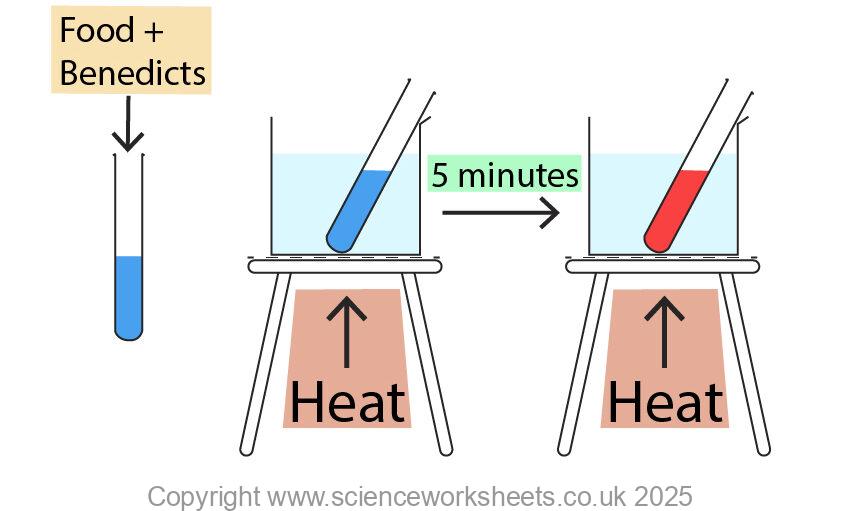
A ground up food sample is added to a test tube along with benedicts reagent or benedicts solution.
The mixture is then heated in a hot water bath for 5 minutes.
If the blue benedicts solution turns red then a sugar is present.
If it stays blue, then sugar is not present.
See the image below
Test for Starch
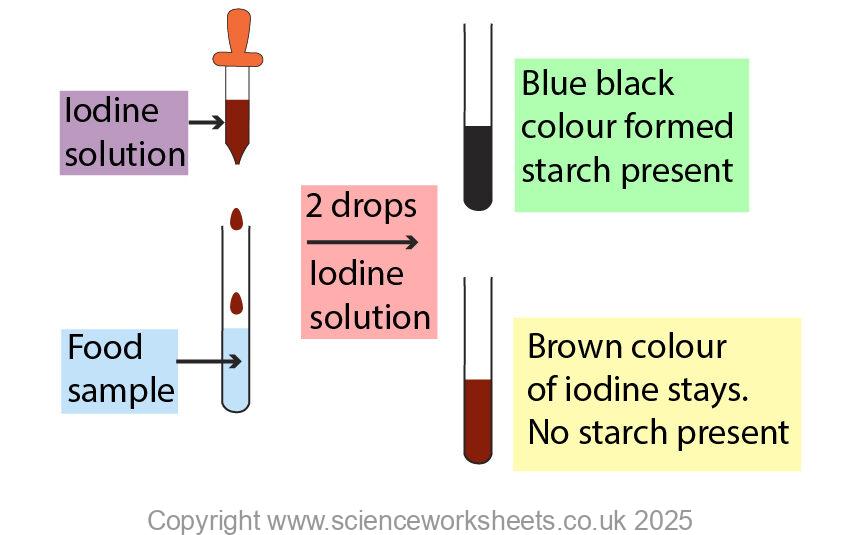
Two drops of iodine solution are added to the food sample.
Iodine solution is a red brown colour, if it stays unchanged then food does not contain starch.
However, if the iodine solution turns blue black, then starch is present.
Ensure you use the phrase “iodine solution” rather than just “iodine”.
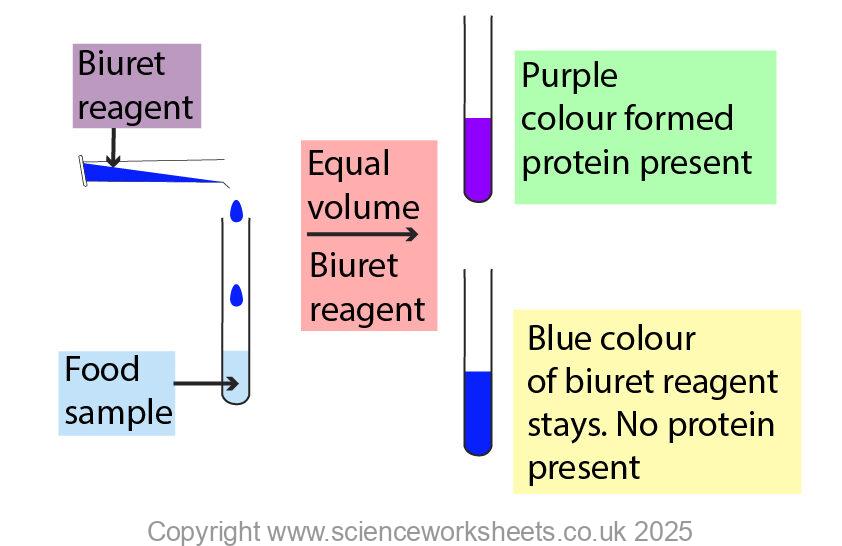
To 2cm3 of food solution, 2cm3 of biuret reagent is added. If the solution turns purple, then protein is present.
Biuret reagent is blue in colour, so if it stays blue, then no protein is present.
Test for Lipids (fats)
To 2cm3 of food sample, add 2cm3 of ethanol and shake thoroughly.
Once thoroughly mixed, pour this mixture into a test tube of water. If a white emusion forms, then lipids are present.
A purple card has been placed behind each test tube, so you can see the white emulsion more clearly as a top layer.

Practice Questions
1.Describe the food test for sugars
2. Describe the food test for starch
3. Amy carried our some food tests on a sample of food. The results are shown below in a table
| Food test | Result |
|---|---|
| Add iodine solution to food sample | Blue black colour formed |
| Add benedicts solution to the food sample and heated | Stays blue |
| Added biuret reagent to the food sample | Turns purple |
| Add ethanol to food, mixture shaken and poured into water | White emulsion formed |
3.State which substances are present in the food sample
Factors affecting the rate of photosynthesis
Measuring & calculating rates of photosynthesis
Inverse square law and photosynthesis
Economics of enhancing the conditions in greenhouses
Investigating the effect of light intensity on the rate of photosynthesis
Data analysis and nervous system
The effect of a factor on human reaction time
Controlling blood glucose concentration
Regulating water and nitrogen levels in the body.
Hormones and human reproduction
Using hormones to treat infertility
Control and coordination in plants using hormones
Investigating the effect of light or gravity on the growth of newly germinated seedlings