AQA GCSE Specialised cells in plants (Biology)
Specialised cells in plants
A specialised cell is one that is adapted to carry out a particular function.
Cells undergo differentiation to form specialised cell types.
Specialised plant cells include:
1.Root hair cells
2.Xylem cells
3. Phloem cells
Root hair cells

Structure:
Have a long, thin extension (root hair) that increases the cell’s surface area.
Thin cell wall to make it easier for water and mineral ions to move through.
Large permanent vacuole to maintain a steep concentration gradient for osmosis.
Lots of mitochondria to release energy (ATP) for active transport of mineral ions.
Function:
Absorb water and mineral ions from the soil.
Provide the plant with essential nutrients and water needed for photosynthesis, growth, and transport.
Relation to tissue/organ/organism:
As part of the root tissue, these cells help the whole root absorb water and minerals.
At the organ level, the root supplies the stem and leaves.
At the organism level, efficient absorption ensures the plant can grow, photosynthesise, and survive.
Xylem cells
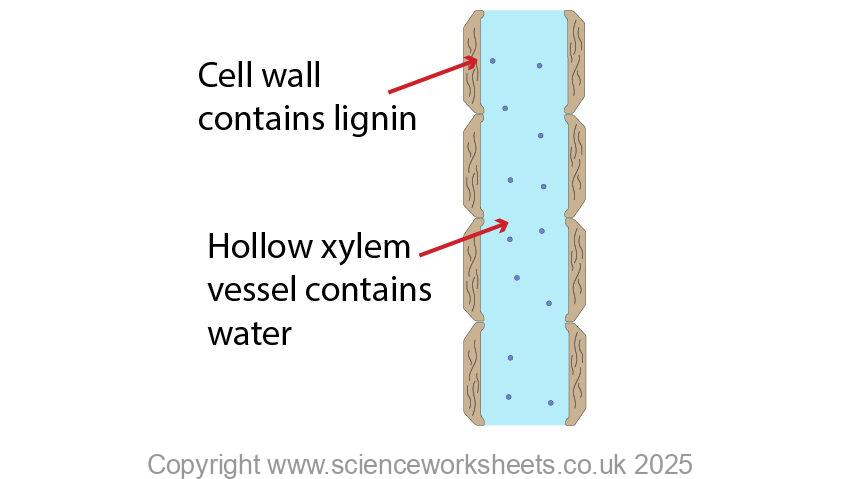
Xylem Cells (plants):
Structure:
Long, hollow tubes formed from dead cells joined end-to-end.
No cell contents (cytoplasm/nucleus) so water can flow freely.
Cell walls thickened with lignin, making them strong and waterproof.
Pits (small holes) in the walls allow sideways movement of water to nearby cells.
Function:
Transport water and dissolved minerals from roots to leaves.
Provide structural support to the plant due to the lignified walls.
Relation to tissue/organ/organism:
As a tissue, xylem forms part of the vascular bundle with phloem.
At the organ level, it helps stems and leaves stay upright and supplied with water for photosynthesis.
At the organism level, it ensures survival by maintaining water transport and mechanical strength throughout the plant.
Phloem cells
Phloem tissue is made up of phloem cells (sieve tube elements) and companion cells.

Phloem tissue (plants):
Structure:
Made of living cells joined end-to-end, forming phloem cells or sieve tubes.
The end walls (sieve plates) have pores to allow the flow of dissolved sugars from cell to cell.
Companion cells next to the sieve tubes contain many mitochondria to supply energy (ATP) for active transport.
Relatively thin cell walls to make transport efficient.
Function:
Transport dissolved sugars (mainly sucrose) made in the leaves by photosynthesis to the rest of the plant.
Movement can go both up and down the plant depending on where sugars are needed (called translocation).
Relation to tissue/organ/organism:
As a tissue, phloem works alongside xylem in the vascular bundle.
At the organ level, it ensures roots, stems, flowers, and fruits receive sugars for growth, storage, or energy.
At the organism level, it distributes food, supporting the plant’s survival, reproduction, and storage of energy.
Practice Question
1. Describe and explain one structural adaptation of a root hair cell.
2. Why do root hair cells contain many mitochondria?
3. What advantage does having a thin cell wall provide to root hair cells?
4. Describe two structural adaptations of xylem cells that allow for efficient water transport.
5. Give two structural adaptations of phloem cells for the transport of sugars and amino acids.
6. How do companion cells support sieve tube elements?
7. State three differences between xylem and phloem vessels.
Factors affecting the rate of photosynthesis
Measuring & calculating rates of photosynthesis
Inverse square law and photosynthesis
Economics of enhancing the conditions in greenhouses
Investigating the effect of light intensity on the rate of photosynthesis
Data analysis and nervous system
The effect of a factor on human reaction time
Controlling blood glucose concentration
Regulating water and nitrogen levels in the body.
Hormones and human reproduction
Using hormones to treat infertility
Control and coordination in plants using hormones
Investigating the effect of light or gravity on the growth of newly germinated seedlings